A customer onboarded two years ago turns up in a law-enforcement inquiry. The first question inside the bank is not whether the customer was bad. It is what the bank knew when it said yes. Who approved the account? Did they see the screening match? Was the risk rating right at the time, or has it been changed since? In too many banks the answer is spread across a case tool, a screening tool, emails and a memo saved in a shared drive.
In short
- Four eyes means a second, independent person. For high-risk customers and PEPs, the person who approves must not be the person who prepared and submitted the case.
- A decision record freezes the evidence. At the moment of decision it keeps every control’s outcome and rule version, the risk assessment and each screening match’s disposition as they stood.
- Controls make “not ready” explicit. Rules that block or refer a case say why, in a sentence, before anyone can approve.
- The rule is enforced by the system, not by memory. An analyst cannot approve a referred case; the submitter cannot approve their own.
Why the decision moment matters
A KYC case changes as it is worked: documents arrive, checks are re-run, matches are disposed of, the rating is overridden. After the decision, the customer keeps changing too: new transactions, a new review, a new rating. If the bank only stores the current state, it can’t answer questions about the past. The decision record is a snapshot taken at the moment someone said yes or no.
| The record keeps | So that later you can answer |
|---|---|
| The verdict, who made it and when, and who submitted | Who approved this, and was it the same person who prepared it? |
| Every case control’s outcome and reason | Did anything block or refer the case, and how was it resolved? |
| The risk assessment, with model version, factors and any override | Why was the customer rated medium then, when they are high now? |
| Each screening match with its disposition | Was every match seen and disposed of? (Who disposed of it, and why, stays on the match in the case.) |
| The approver’s note, signed off as a human decision | What did the approver say at the time? |
Controls before the decision
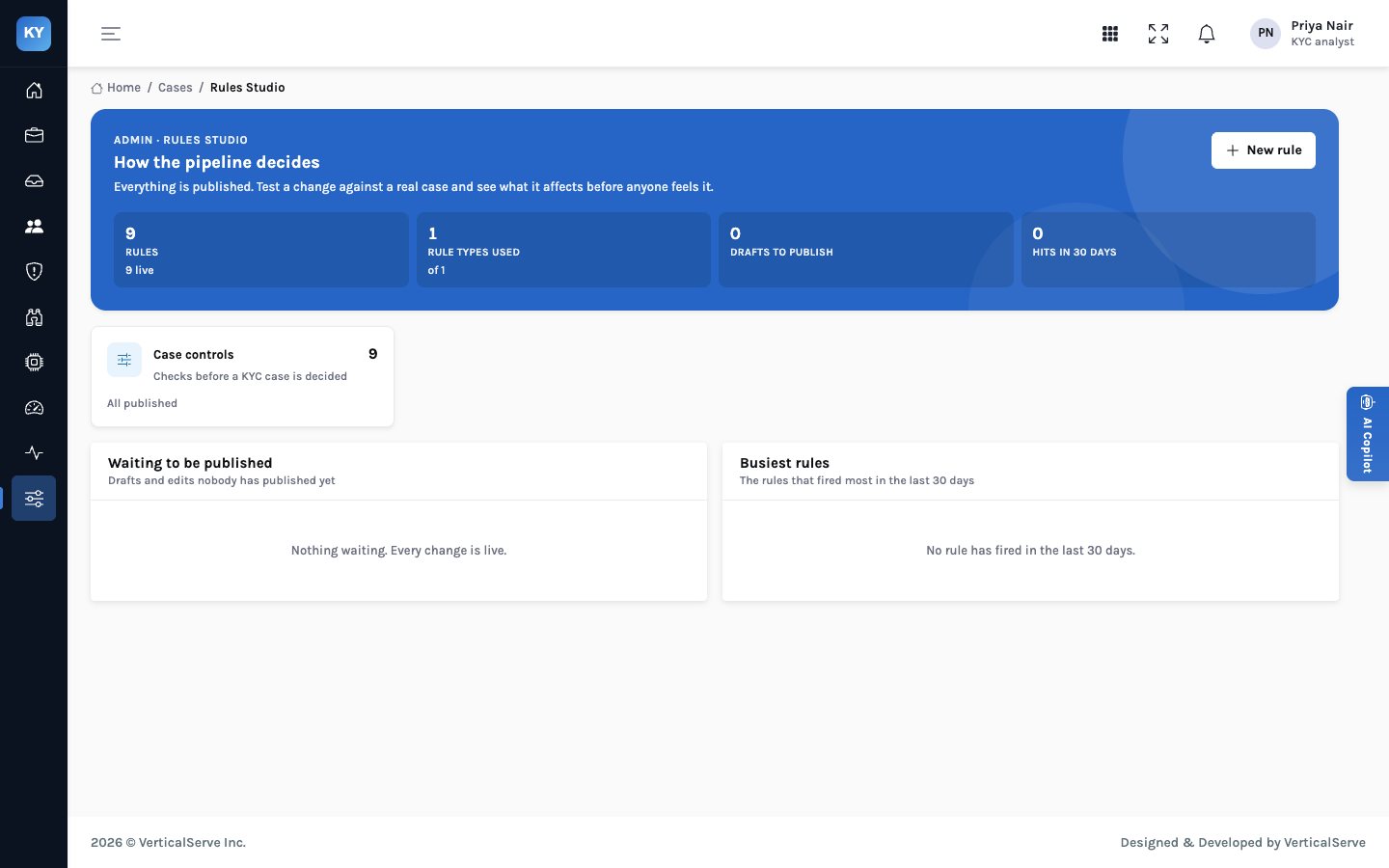
InsightKYC’s decision gate is a set of case controls kept in Rules Studio, the same rules engine the platform uses elsewhere. The demo ships nine. Seven block approval outright until the issue is resolved; two refer the case to a second approver.
| Control | Outcome | Fires when |
|---|---|---|
| SANCTIONS_TRUE_MATCH | Block | A screening match has been confirmed as a sanctions true match |
| OPEN_STRONG_HITS | Block | A strong screening match is still open |
| OPEN_HITS | Block | Any screening match is still open |
| FAILED_CHECKS | Block | A verification check failed and hasn’t been resolved or waived |
| UBO_UNVERIFIED | Block | A beneficial owner has no verified identity document |
| EDD_OPEN | Block | Enhanced due diligence is required and not complete |
| PROHIBITED | Block | The customer is in a prohibited jurisdiction or industry |
| HIGH_RISK_APPROVAL | Refer | The rating is high: a lead other than the submitter approves |
| PEP_APPROVAL | Refer | A party is a politically exposed person: likewise |
Each control produces a sentence the analyst reads before deciding, such as “A strong screening match is still open: dispose of it before a decision.” The case header shows these as “Before a decision”, so nobody discovers a blocker by having the approve button fail.
Four eyes, enforced
The approver is checked against the submitter at the moment of approval, not just when the case was routed.
In the demo, an analyst can approve a low- or medium-risk case whose controls all pass. For a high-risk customer or a PEP, the analyst submits; the Approve button appears only for a lead, and only for a lead who isn’t the submitter. The controls are evaluated again at the moment of the decision, so a case that changed after submission can’t be approved on stale results.
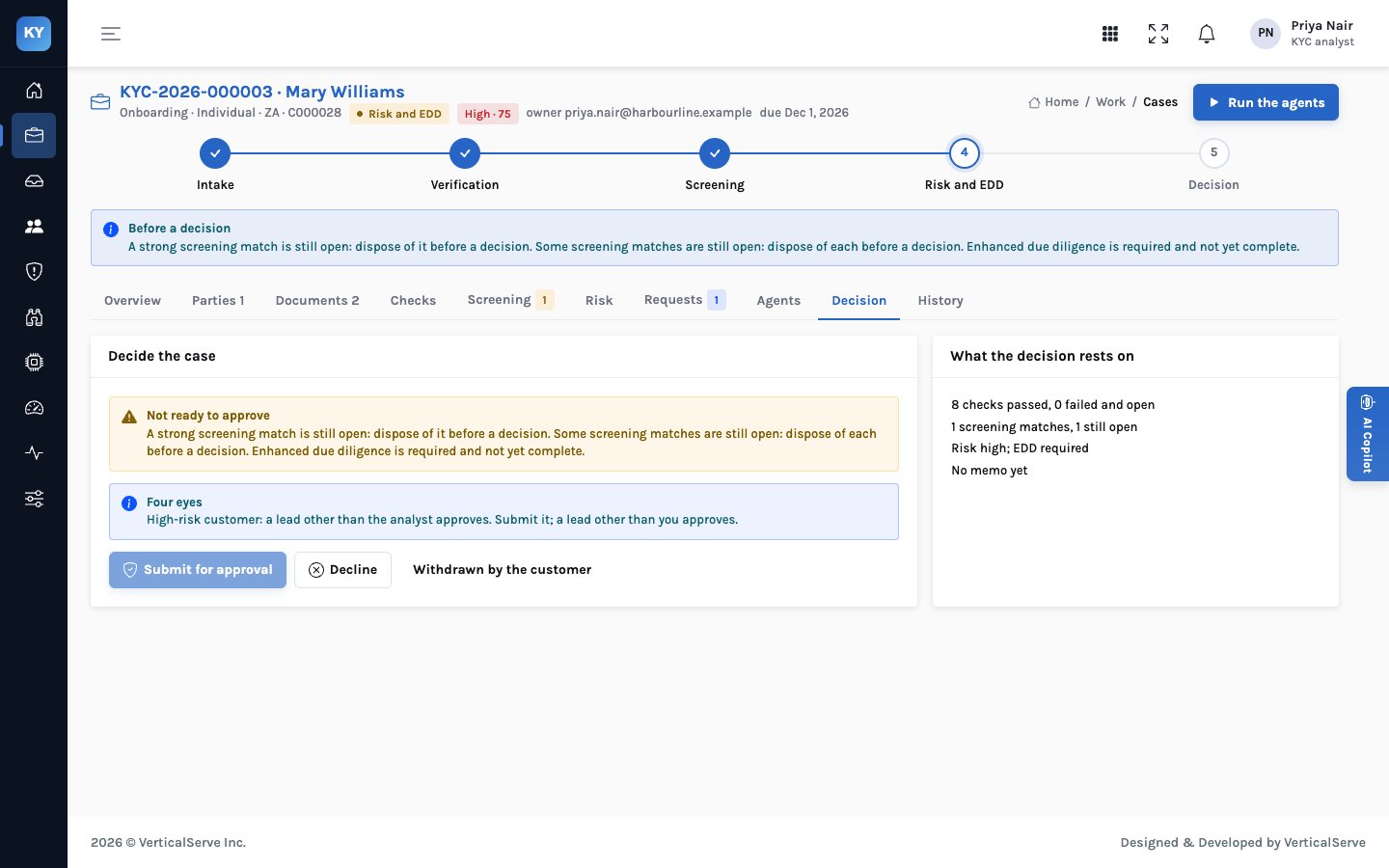
Dispose of matches, resolve or waive failed checks with a reason, complete EDD. The case header lists what remains.
The case writer drafts the memo from the checks, screening, ownership and risk; the analyst edits and saves it.
With a note. The case records who submitted and when.
The controls run again. A decline needs a written reason. The decision record is written with the decision itself.
On approval the customer’s next review date follows the rating: one, two or three years in the demo policy.
Waivers are decisions too
Not every failed check means the customer is unsuitable. A name on a utility bill might differ by a middle name that the passport confirms. InsightKYC lets the analyst waive a failed check, but only with a written reason, and the waiver and its author are kept on the case. A waived check shows as waived, never as passed.
The file shows a pass. Nobody can tell there was ever a discrepancy, or who accepted it.
“Name differs by a middle name; confirmed by the customer’s second ID”, with the analyst’s name and the time.
What agents contribute, and what they don’t
The supervisor agent reads the controls and says whether the case is ready, and why not. The case writer drafts the memo. Neither can submit or decide: submit case is a prepared decision a person accepts, and approval is not an action any agent has. When a person accepts or rejects an agent’s prepared decision, that answer goes on the decision record too.
What it means for each audience
For the CCO & MLRO
When a past approval is questioned, the record answers it: who, when, on what evidence, and what the controls said at that moment.
Segregation of duties for high-risk and PEP approvals is enforced by the system and visible on every case.
For the KYC operations lead
Analysts see what blocks a decision as it happens, not when approval fails. Leads see a submitted case with the memo and the controls already evaluated.
Waivers are fast, but never silent.
For the board
The bank can show that higher-risk relationships were approved by someone senior who didn’t prepare them.
Decision quality becomes measurable: overrides, waivers and declines by reason.
What to be careful about
- Four eyes can become a rubber stamp. A second approver who never declines or questions is not a control. Sample their decisions.
- Which cases need it is policy. The demo refers high risk and PEPs. Many banks add thresholds on expected volume, or specific industries. Add them as rules, not as a habit.
- A frozen record isn’t a frozen customer. The record shows what was known. Ongoing monitoring and periodic review are what catch what changed.
The question after something goes wrong is always the same: what did we know when we said yes?
Answer it once, at the moment of decision, by freezing the controls, the rating and the dispositions with the names of the people who decided.