- contact@insightkycai.com
AI agents
Agents that prepare the case, and people who decide it
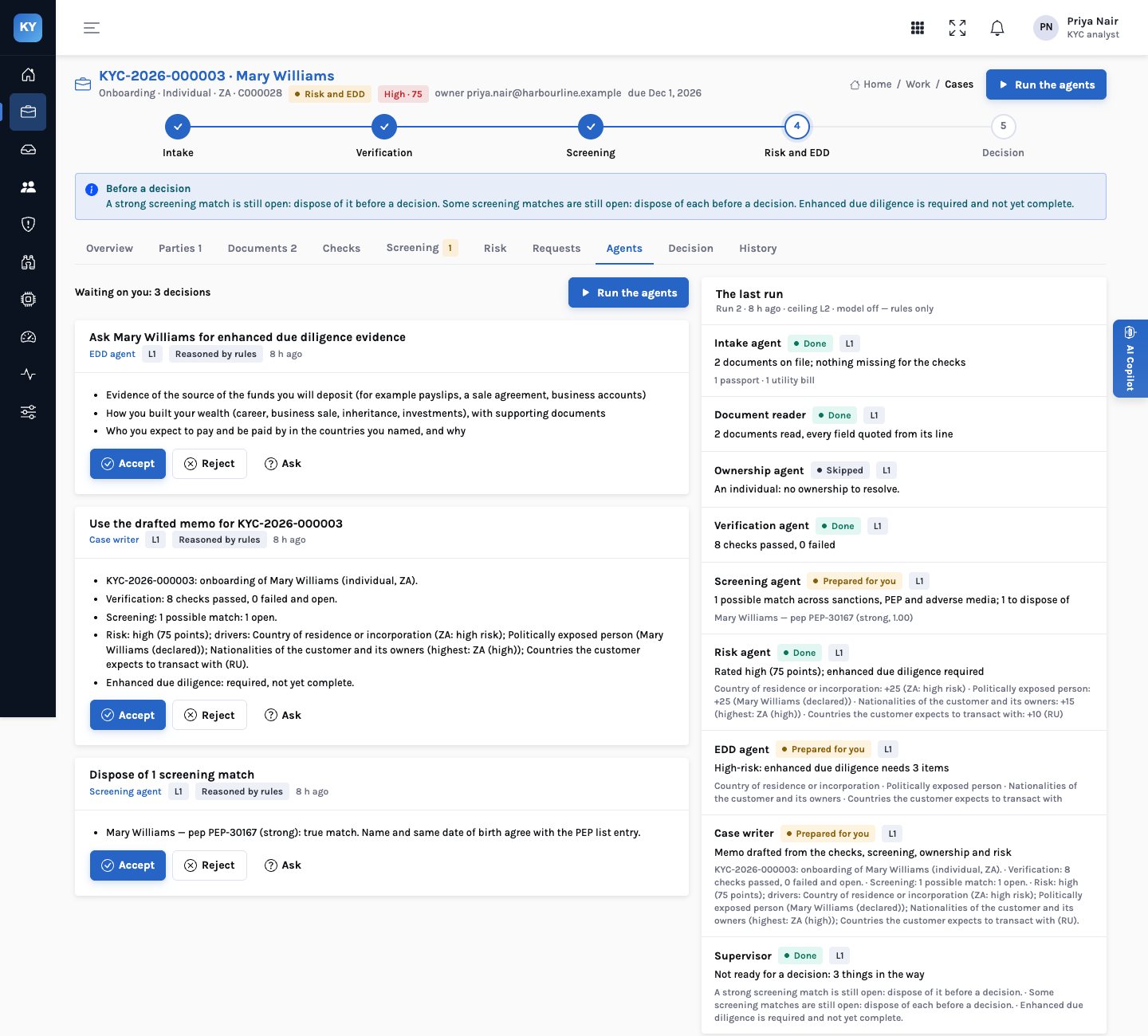
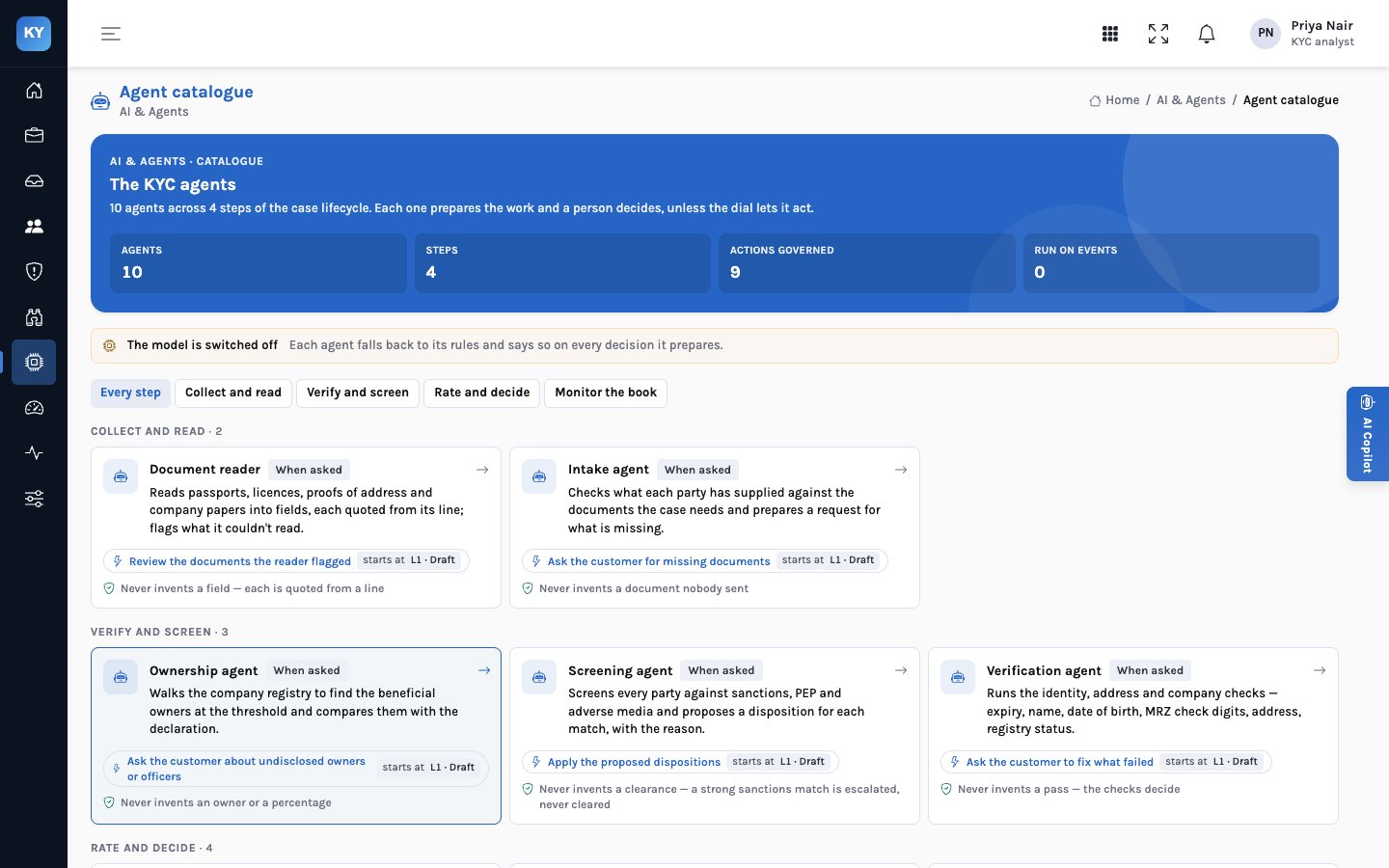
Ten agents, one per stage of the case. They read, check, screen, rate and draft. They don’t clear matches, waive checks, send to customers or decide.
The ten agents
One stage each, and a line none of them crosses
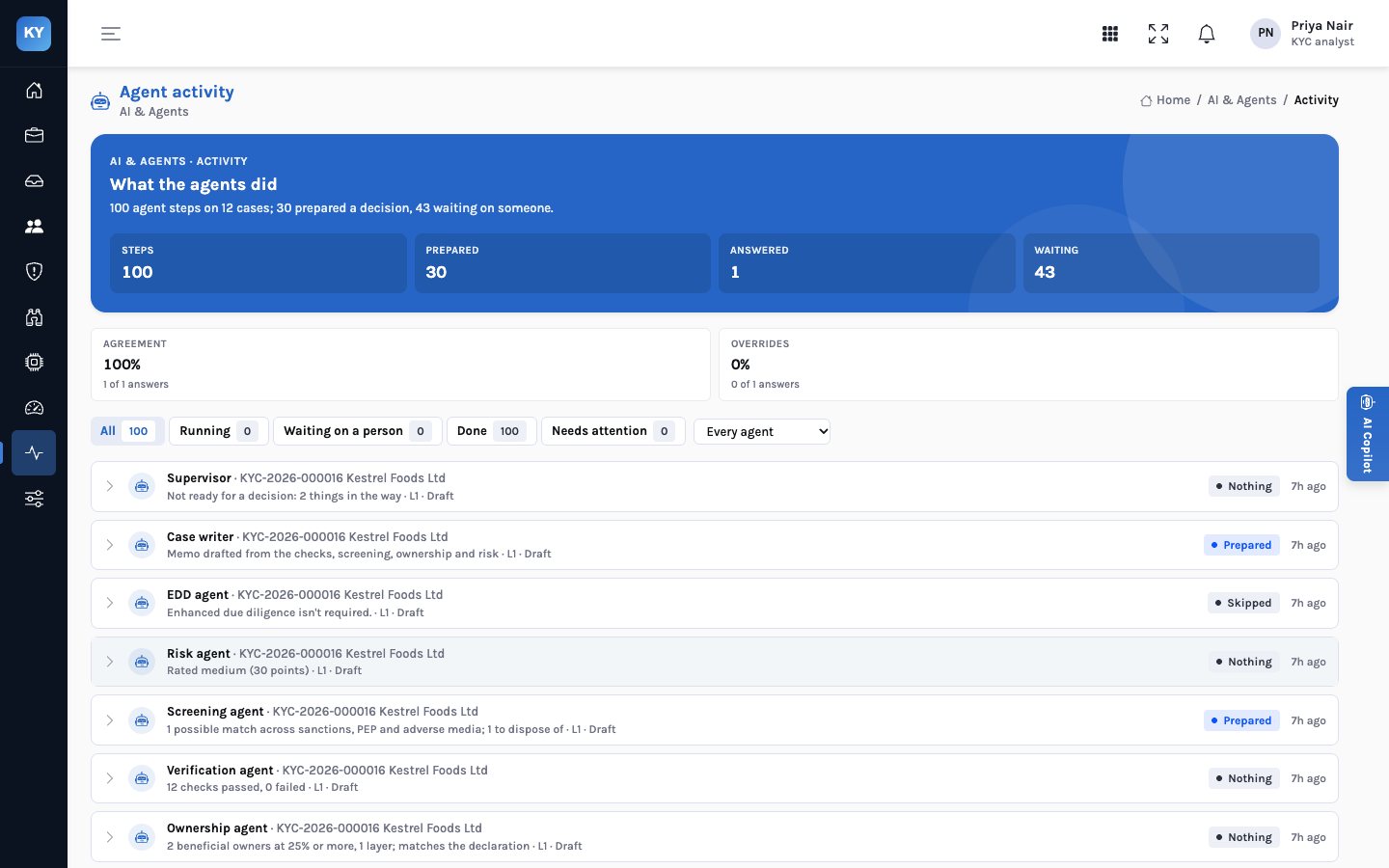
Every agent writes what it found and why. When a person needs to act, the agent prepares the decision and waits.
| Agent | Stage | What it prepares | What it never does |
|---|---|---|---|
| Intake | Intake | What is on file and what is missing; a request for the missing documents | Send the request |
| Document reader | Intake | Fields from each document, quoted from their lines; the ones it couldn’t read | Invent a field |
| Ownership | Verification | Beneficial owners from the registry; a request about undisclosed owners or officers | Invent an owner or a percentage |
| Verification | Verification | Identity, address, MRZ and company checks; a request to fix what failed | Pass a check without evidence, or waive one |
| Screening | Screening | A proposed disposition for each match, with the reason | Clear a strong sanctions match, or dispose of anything itself |
| Risk | Risk | The rating with every factor’s points and reason | Override a rating |
| EDD | Risk | Whether enhanced due diligence is needed; the request for source of funds and wealth | Record EDD as complete |
| Case writer | Decision | The case memo, from the checks, screening, ownership and risk | Add a fact that isn’t on the case |
| Supervisor | Decision | Whether the case is ready for a decision, and what is in the way | Submit or decide the case |
| Monitoring | Customer book | Alerts from transactions against each customer’s declared profile | Close an alert or open a review |
Autonomy
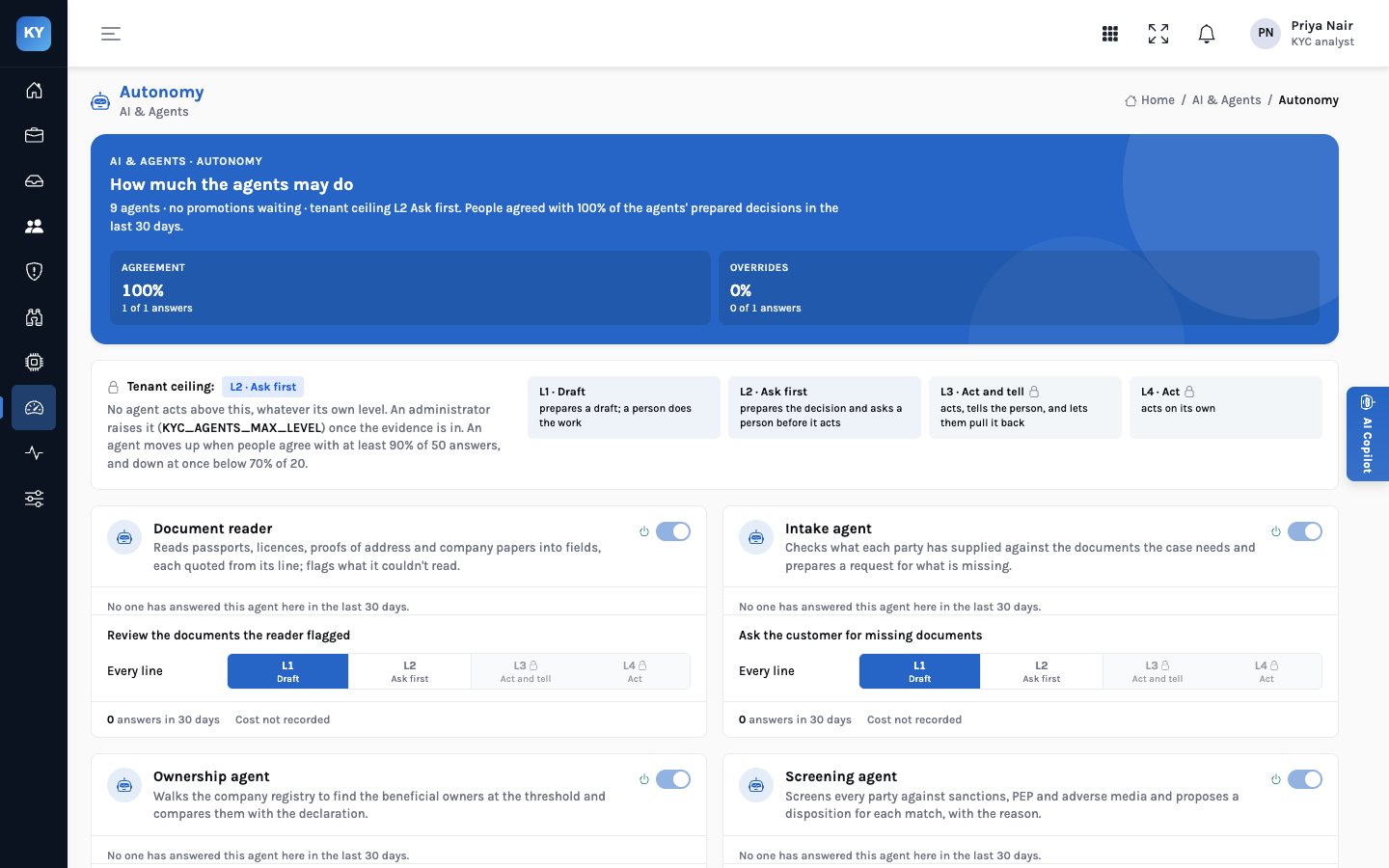
Autonomy is earned, one level at a time
Each agent starts at L1. An administrator can raise it once people agree with what it prepares; the tenant ceiling caps every agent at L2 (Ask first). An agent moves up only after people agreed with at least 90% of 20 answers, and drops back if agreement falls below 70%.
| Level | Name | What the agent may do |
|---|---|---|
| L1 | Draft | Prepares a draft; a person does the work |
| L2 | Ask first | Prepares the decision and asks a person before it acts. The ceiling for every InsightKYC agent today |
| L3 | Act and tell | Acts, tells the person, and lets them pull it back. Locked |
| L4 | Act | Acts on its own. Locked |
Grounding
The model explains. It never supplies the facts.
Checks, ownership arithmetic, match scores and risk points are deterministic code. Where a language model is used, it reasons over the case’s facts and phrases what the agent found; an answer that cites something not on the case is rejected and the agent falls back to its rules.
Deterministic
Arithmetic is code
Effective ownership, check digits, match scores and risk points are calculated, not generated.
Grounded
Facts come from the case
Every line an agent writes refers to a document line, a registry record, a list entry or a transaction.
Fallback
Model off is a supported mode
With the model switched off, every agent runs on its rules and says so on each step.
Prepared decisions
Accept, reject or ask
What an agent prepares lands on the case and on the analyst’s home. Accepting carries it out; rejecting records that a person disagreed; asking sends a question back. Each answer is kept on the decision record and counts toward the agent’s agreement rate.