Most of a KYC case is preparation: reading documents, typing fields, walking a registry, screening names, adding up risk points and writing a memo. Very little of it is judgement. That makes KYC a good fit for AI agents, and a dangerous one, because the small part that is judgement is exactly what a supervisor will ask about. The design question isn’t whether agents can do the work. It is which decisions they must never take, and how that is enforced rather than promised.
In short
- Give each agent one job on the case. Ten agents, each with a narrow role: read documents, walk the registry, screen, rate, draft the memo, and so on.
- Agents prepare; people decide. Anything that reaches the customer, clears a match, waives a check or decides the case is a prepared decision a person accepts, rejects or questions.
- Autonomy is a dial with a ceiling. Every action starts at “Draft”. It can move up only on evidence that people agree with it, and never above the tenant’s ceiling.
- Facts come from the case, not the model. Every figure an agent writes must exist in the case’s facts, or the model’s answer is rejected and the agent falls back to its rules.
Ten agents, one case
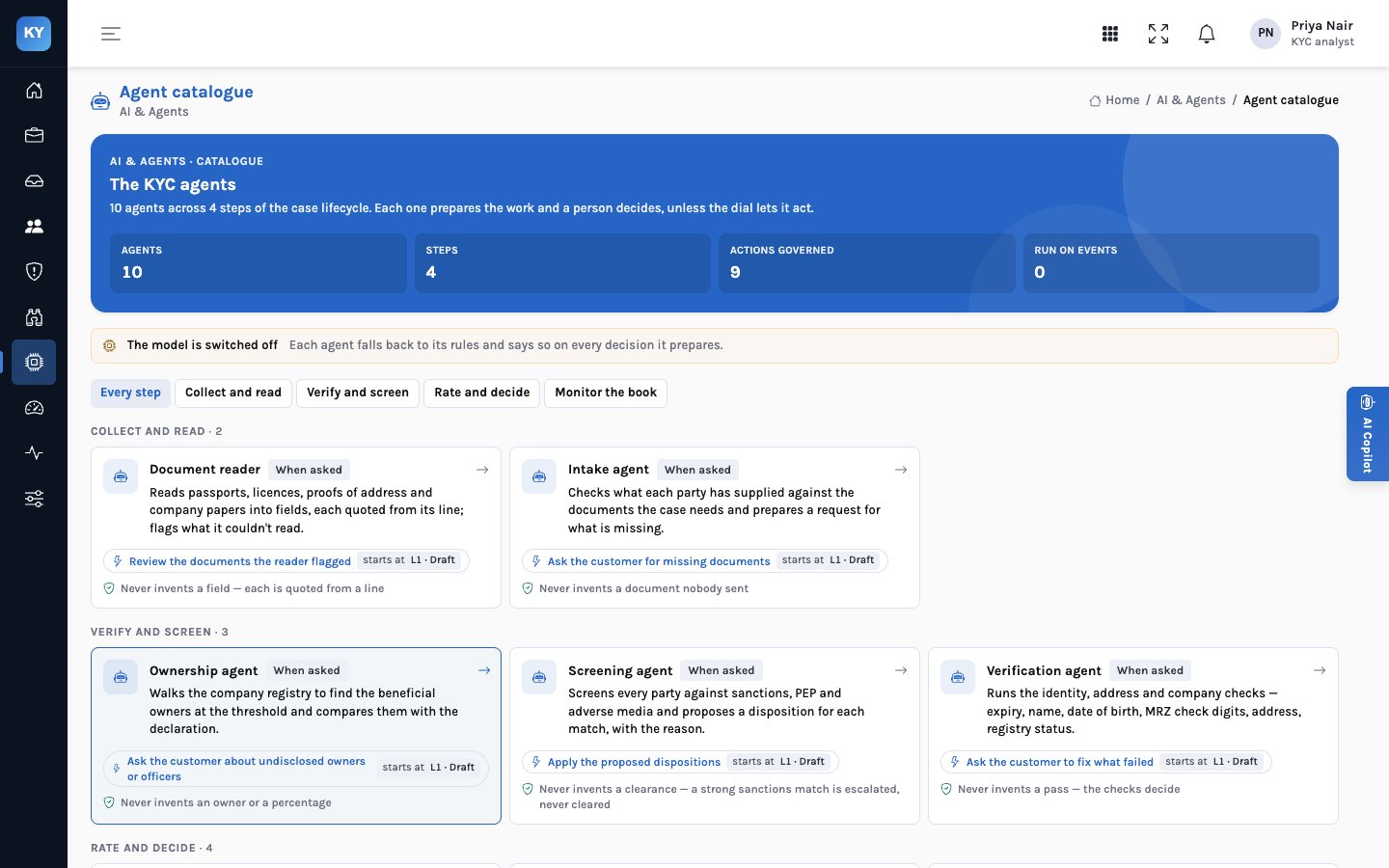
InsightKYC runs ten agents. Nine work a case in order; the tenth watches the customer book.
| Agent | What it does | What it can prepare for a person |
|---|---|---|
| Intake | Checks the documents the case needs against what the customer supplied | A request to the customer for what is missing |
| Document reader | Reads passports, licences, proofs of address and company papers into fields, each quoted from its line | Documents it couldn’t read, for review |
| Ownership | Walks the registry to find beneficial owners at the threshold and compares them with the declaration | A request about undisclosed owners or officers |
| Verification | Runs identity, address and company checks: expiry, name, date of birth, MRZ check digits, registry status | A request to fix what failed |
| Screening | Screens every party against sanctions, PEP and adverse media and proposes a disposition for each match | Its proposed dispositions, never for a strong sanctions match |
| Risk | Rates the customer on the points model | — (rating is deterministic; a lead overrides) |
| EDD | Decides whether enhanced due diligence is needed and what to ask | A source-of-funds and source-of-wealth request |
| Case writer | Drafts the memo from the checks, screening, ownership and risk | The memo, for the analyst to accept or edit |
| Supervisor | Reads the controls and says whether the case is ready, and what is in the way | Submitting the case for a decision |
| Monitoring | Reads active customers’ transactions against what they declared | Opening reviews for the alerts it raised |
What no agent does
The line between preparing and deciding is drawn around actions with consequences outside the case, or that a regulator would expect a named person to own:
| Action | Who | Why |
|---|---|---|
| Send anything to the customer | A person, from a held request | What the bank asks a customer is a communication on its behalf |
| Clear a strong sanctions match | A person, with a reason | The cost of a wrong clearance is the highest in the programme |
| Waive a failed check | A person, with a reason | A waiver is a judgement that the evidence is good enough |
| Override a risk rating | A lead, with a reason | The rating sets the diligence and the approver |
| Approve or decline a case | An analyst, or a second lead for high risk and PEPs | The decision is the bank’s, and it goes on the decision record |
Enforced in code, not in a prompt
These actions aren’t forbidden by telling the model not to do them. The agents simply have no way to do them: the functions that send, waive, override and decide take a person as the actor, and the routes check the person’s role.
A prepared decision
When an agent finds something only a person can act on, it prepares a decision: a title, the lines of evidence, why it thinks so, and the action that will happen if the person accepts. The person has three answers.
Every answer, including a rejection, is recorded. Rejections are how the agents’ autonomy is held down.
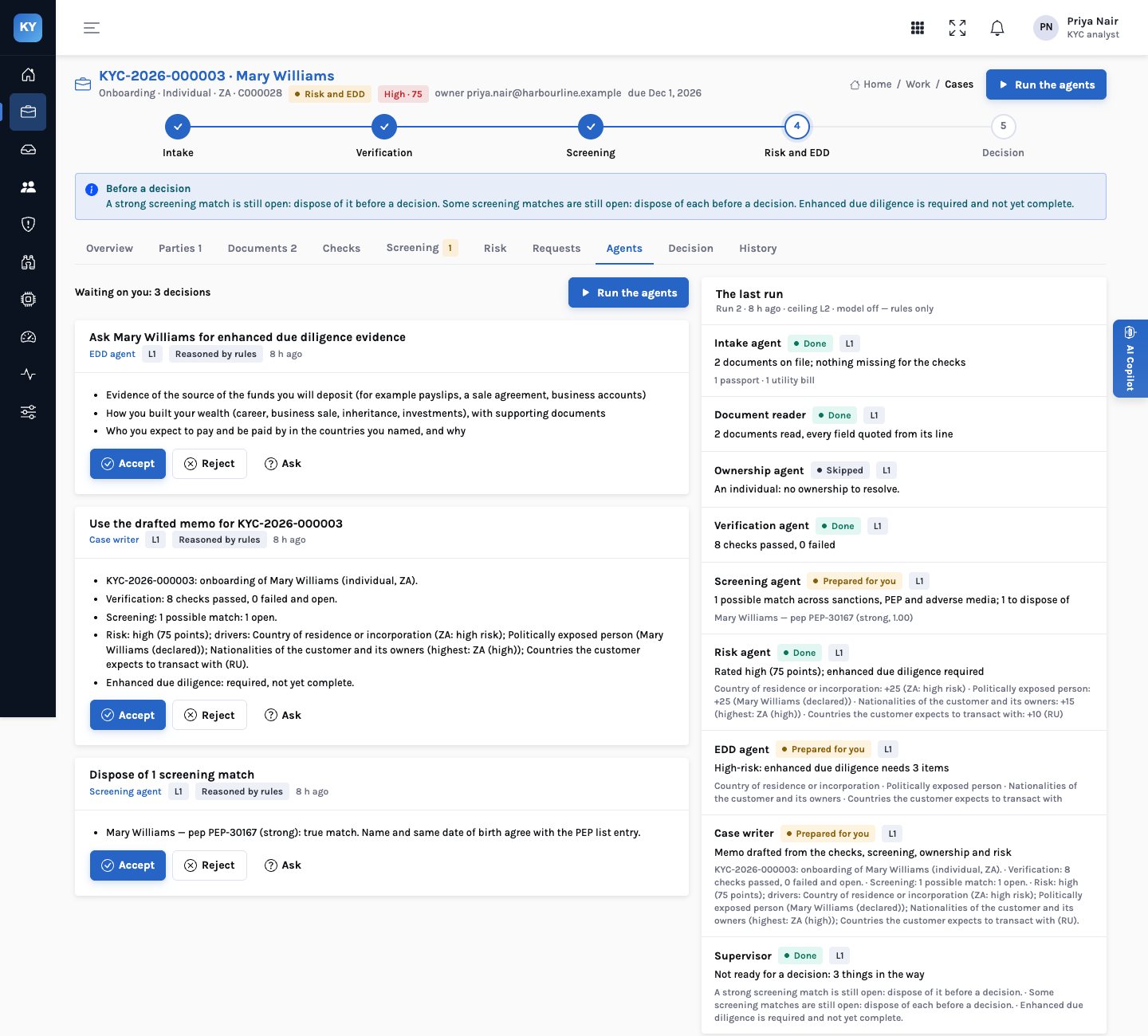
Even accepting doesn’t send anything to a customer. Accepting the intake agent’s request creates a request held for review on the Requests tab, where the analyst edits the wording and sends it. Two deliberate steps, because a message to a customer is hard to take back.
Autonomy is earned, per action
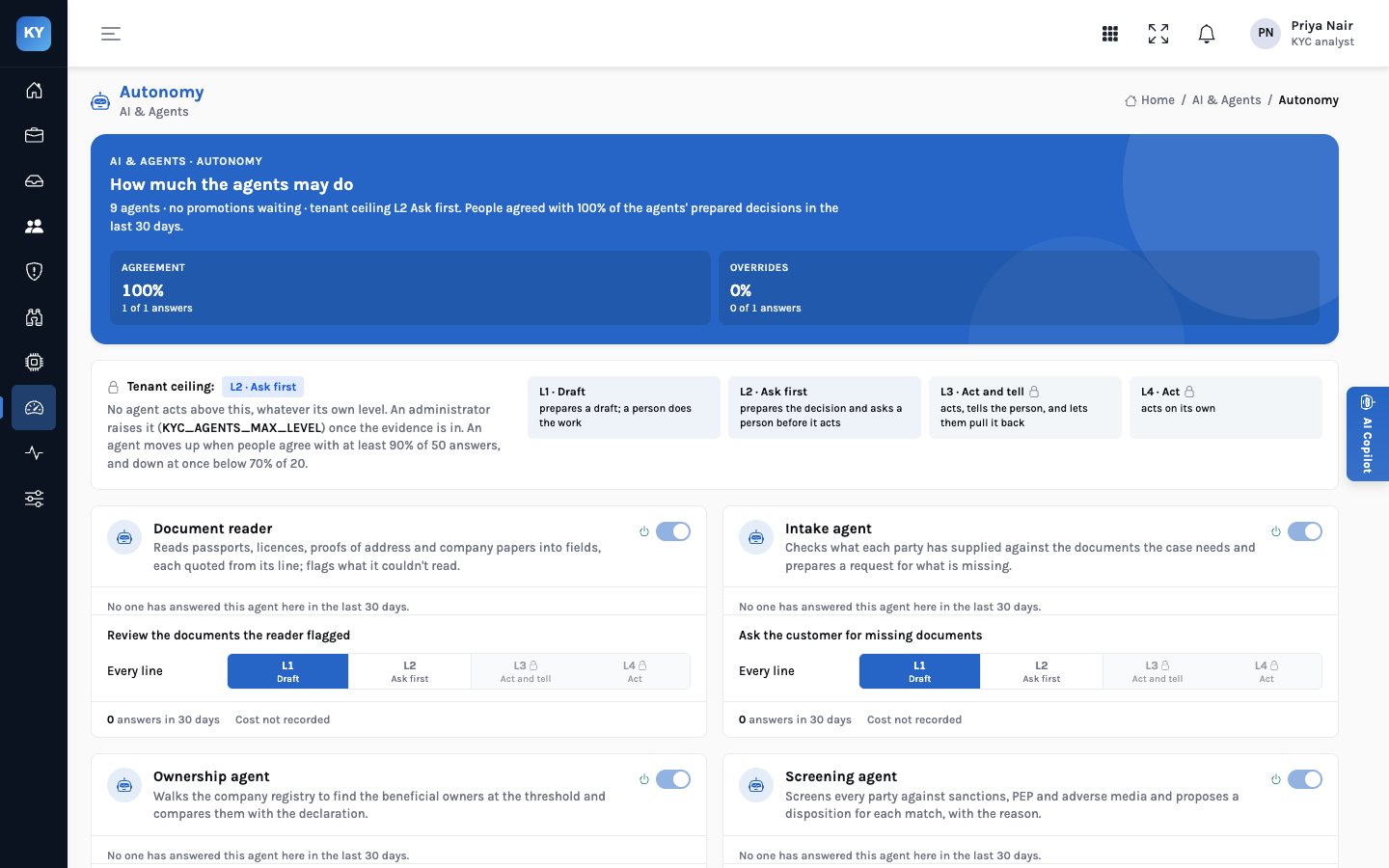
Each action has a level, and every action starts at the lowest:
| Level | Name | What happens |
|---|---|---|
| L1 | Draft | The agent prepares a draft; a person does the work |
| L2 | Ask first | The agent prepares the decision and asks a person before it acts |
| L3 | Act and tell | The agent acts and tells the person, who can pull it back |
| L4 | Act | The agent acts on its own |
In InsightKYC the tenant’s ceiling is L2, so no KYC agent acts on its own whatever its record. Within the ceiling, an action moves up only when people have agreed with at least 90% of its last 20 prepared decisions, and moves down at once if agreement falls below 70%. An administrator can lower the ceiling further for any agent.
The model is optional; the facts are not
Each agent has a rules path that works with no language model at all: the demo runs with the model switched off, and every screenshot here comes from that mode. When a model is switched on, it can phrase the reasoning and the memo better, but its answer is checked: every number and name it writes must exist in the facts the agent gave it. An answer that introduces a figure the case doesn’t contain is rejected, the rules answer is used instead, and the step is marked so a person can see it happened.
Fluent, and occasionally wrong: a percentage that isn’t in the registry, a date that isn’t on the passport. Nobody can tell which sentences to trust.
Every figure is checked against the case’s facts. An ungrounded answer is discarded and the rule-based draft is shown instead.
Who does what on a case
The nine case agents run in order; each records what it did, what it found and how long it took.
Accept, reject or ask on each prepared decision. Answers go on the decision record and count towards each action’s agreement rate.
Dispose of matches, waive or resolve checks, send held requests, edit the memo.
When the customer answers or the case changes, the agents run again on the new facts.
The supervisor agent says when nothing blocks; the decision is a person’s.
What it means for each audience
For the CCO & MLRO
The boundary between automation and judgement is written into the product, not into a procedure manual. Every agent action has a level, an owner and a history.
When a supervisor asks “who decided?”, the answer is always a named person.
For the KYC operations lead
Analysts start each case with the reading, checking, screening and drafting done, and a short list of decisions waiting.
Agreement rates tell you which agents to trust more, and which rules need work.
For the board
AI shortens onboarding without moving accountability. That is the version of AI in compliance that survives an examination.
Autonomy can rise later, on evidence, within limits the bank sets.
What to be careful about
- Agreement can be lazy. If analysts accept everything, the agreement rate rises without meaning anything. Sample accepted decisions as you would sample dispositions.
- Agents inherit the data’s gaps. An agent can’t find an owner the registry doesn’t record. The prepared decision says what it looked at; read that.
- Raising the ceiling is a governance decision. Treat it like a policy change, with an owner, evidence and a date to look again.
Let agents do everything that is preparation. Make sure they can’t do anything that is a decision.
Narrow roles, prepared decisions, autonomy earned on evidence under a ceiling, and every figure checked against the case.