Kestrel Freight LLC applies for a business account. The application names one owner, Diego Hernandez, at 30%, and two directors. Everything on the form checks out. The problem is what the form leaves out: a Cayman Islands holding company that owns 70% of Kestrel, and the woman who owns 80% of that holding company. Through the chain she holds 56% of the applicant, more than anyone the application names.
In short
- The application is a claim, the registry is evidence. A declared ownership structure has to be compared with what the company registry shows, holding by holding.
- Effective ownership is multiplied down the chain. 80% of a company that owns 70% is 56%. A person can sit far above the 25% threshold without appearing on the applicant’s own register.
- An undisclosed owner is not automatically a refusal. It is a question the customer must answer, with evidence, before anyone decides.
- The agents find it and draft the question; a person sends it and decides. Nothing reaches the customer, and nothing is approved, without an analyst.
The situation
This case is on InsightKYC’s demo data: a fictional bank, Harbourline Bank, with a fictional
company registry, fictional customers and invented screening lists. The case is
KYC-2026-000004, an onboarding for Kestrel Freight LLC, a US freight business, customer
C000517.
| What the application says | What the registry shows |
|---|---|
| Diego Hernandez owns 30% | Diego Hernandez holds 30% of Kestrel Freight LLC directly |
| No other owner above 25% | Basalt Ventures Ltd, incorporated in the Cayman Islands, holds the other 70% |
| — | Olga Orlov holds 80% of Basalt Ventures Ltd |
| Directors: Diego Hernandez, Christopher Miller | The same two directors |
Nobody has lied on a form in any way that a single check would catch. The application is internally consistent. The directors match. Diego’s passport, date of birth and machine-readable zone all pass. The gap only appears when someone walks the registry beyond the applicant itself, through the holding company, and multiplies.
Why this gets missed
In a manual process, the analyst reads the application, collects identity documents for the people named on it, and screens those people. Each step is done correctly. But every step starts from the names the customer supplied, so a person the customer didn’t supply is never identified, never documented and never screened.
- The register of members of the applicant shows Basalt Ventures Ltd, a company, not a person. It is easy to note “corporate shareholder” and move on.
- The holding company is offshore. Its own register is in another jurisdiction, and asking for it adds days to an onboarding that is already late.
- The arithmetic is done in someone’s head, if at all. A chain of three or four holdings at different percentages is where those mental sums go wrong.
What the rules ask for
The US Customer Due Diligence Rule (31 CFR 1010.230) defines a beneficial owner of a legal entity customer as each individual who owns, directly or indirectly, 25% or more of its equity interests, plus one individual with significant responsibility to control it. FATF Recommendation 24 asks countries to ensure adequate, accurate and up-to-date beneficial ownership information. “Indirectly” is the operative word here: ownership through a holding company counts.
How InsightKYC walks the chain
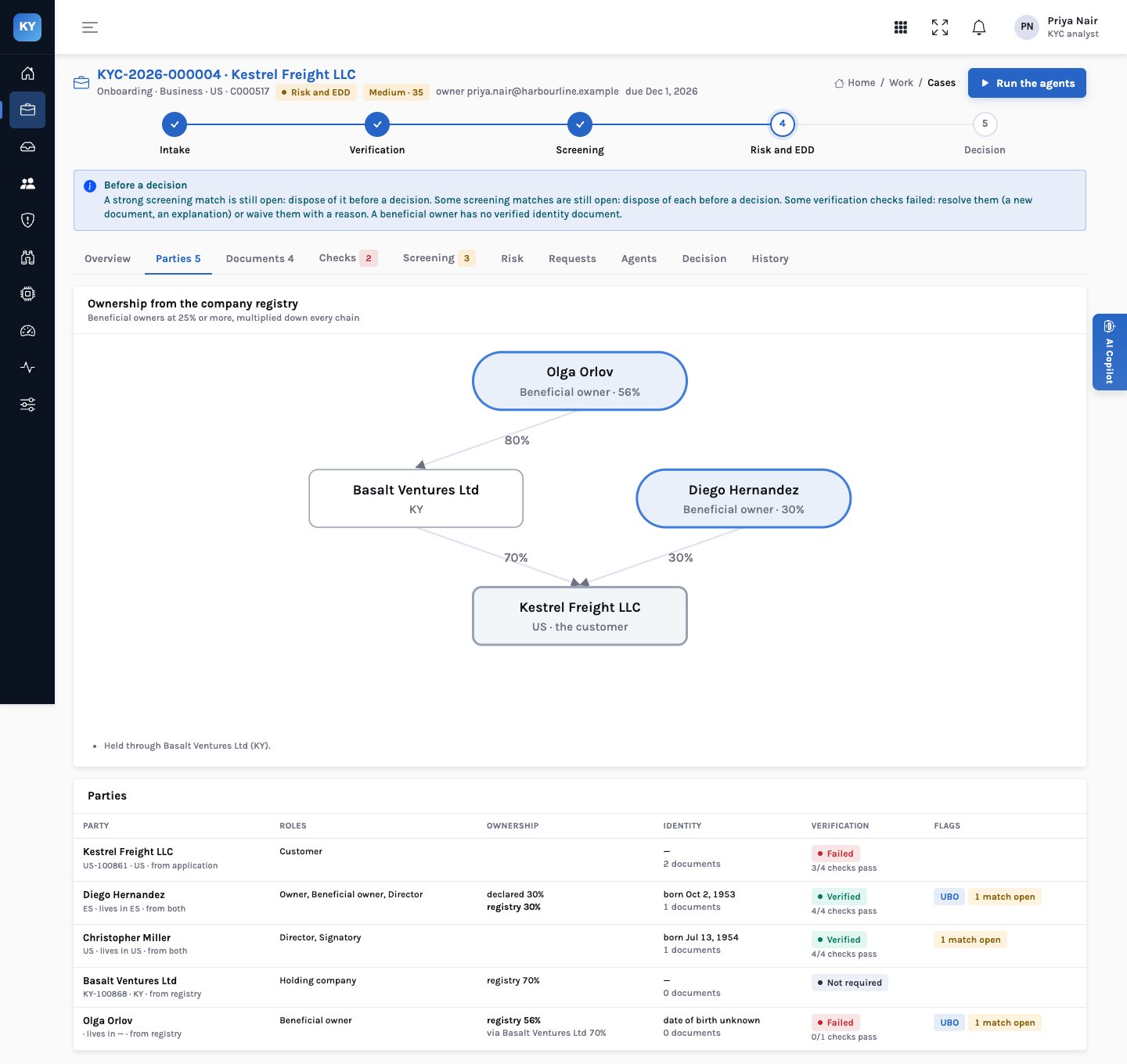
When the case opens, the ownership agent starts at the applicant’s registration number in the registry and follows every shareholding upward until it reaches people. At each step it multiplies the percentage along the chain. Anyone at or above the bank’s threshold (25% in the demo, configurable) is a beneficial owner. Holding companies and directors are added to the case as parties with the source recorded as “registry”.
Effective ownership: 80% of Basalt × 70% of Kestrel = 56%. Diego’s 30% is direct.
The resolved tree is then compared with the declaration. That comparison produces findings, each of which becomes a check on the case:
| Finding | On this case | What it blocks |
|---|---|---|
| Undisclosed beneficial owner | Olga Orlov, 56% via Basalt Ventures Ltd 70% | Approval, until resolved or waived with a reason |
| Beneficial owner without identity document | No passport, driver’s licence or national ID for Olga Orlov | Approval (the UBO-unverified control) |
| Declared percentage differs | None: Diego’s 30% agrees | — |
| Undisclosed officer | None: both directors were declared | — |
What else the case found
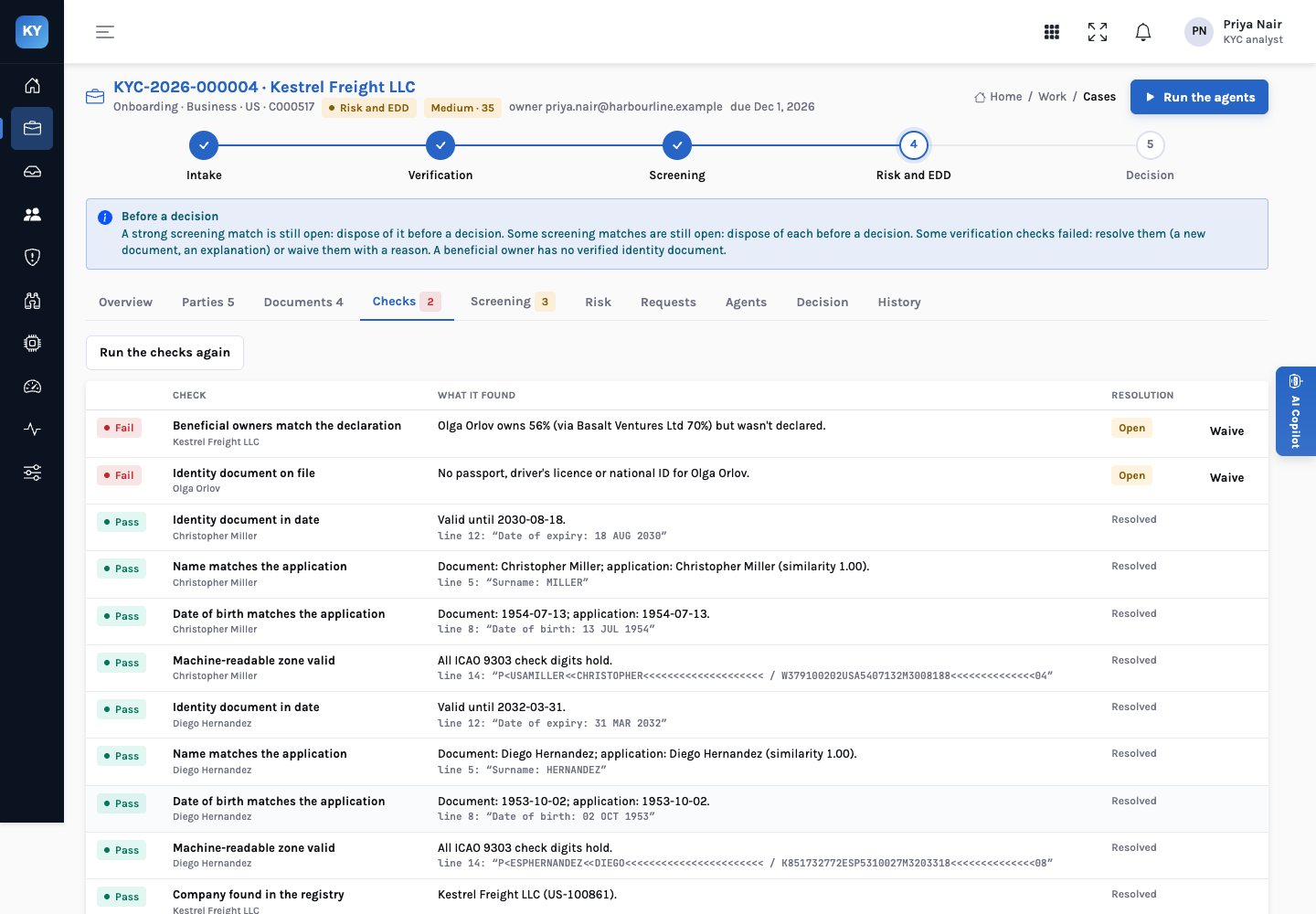
Ownership is only one part of the case. The same agent run read the four documents on file, ran the identity checks for the two directors, screened every party, including the new ones from the registry, and rated the risk.
- Checks: two failed and open: the undisclosed owner and the missing identity document. Every other check passed, each quoting the line of the document it relied on.
- Screening: three possible matches open. Every party was screened, including Olga Orlov, who would never have been screened if the case had started from the application alone.
- Risk: medium, 35 points, with the holding layer in the Cayman Islands contributing to ownership complexity.
Who does what
The agents prepare each step. The two people decide: the analyst on what to ask, the lead on the outcome.
Walks the registry from the applicant upward, multiplies holdings along each chain, adds holding companies, owners and directors to the case as parties with their source.
Raises a failed check for each owner or officer the application didn’t name, and for each percentage that differs.
Prepares a request for what is missing. The analyst reviews it on the Agents tab, accepts it, and edits the wording on the Requests tab.
The request is held until a person sends it. The customer gets a link without a login; InsightKYC keeps only a fingerprint of the token.
Uploads are read as they arrive, the fields quoted from their lines, and the checks run again on the new evidence.
Once the controls pass, the case can be approved. A refusal, or approval with a waiver, carries a written reason on the decision record.
The question to the customer
An undisclosed owner might be an innocent mistake. Small businesses often don’t realise that a shareholder of their shareholder counts. It might also be deliberate. Either way the bank’s next move is the same: ask, specifically, and wait for evidence.
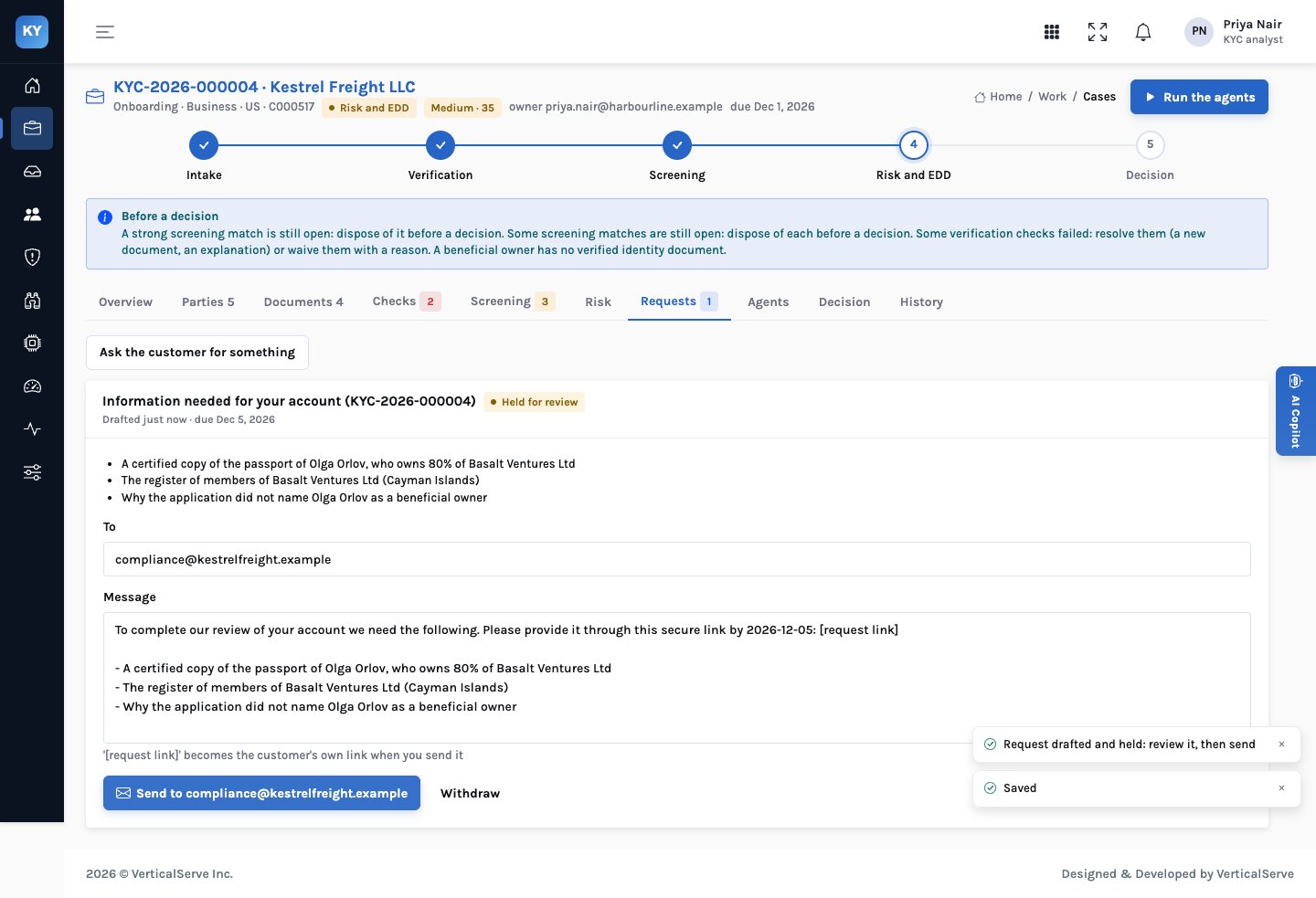
The request is specific because the case is specific. It names the person, the holding company and the percentage. A generic “please provide details of all beneficial owners” invites a generic reply that restates the application.
The customer re-sends the same declaration. The analyst has nothing new to check, and the case waits for another round.
The customer has to send the register of members and Olga’s passport, or explain why the registry is wrong. Either answer moves the case.
Outcomes, and what each means
| What the customer sends | What happens | Likely outcome |
|---|---|---|
| Passport and register confirming Olga’s 80% | Identity checks run on Olga; she is screened with full date of birth; ownership finding resolved with the explanation | Proceed to risk and decision, possibly with enhanced due diligence |
| A register showing a different structure | The registry discrepancy is recorded; the analyst asks which is current | Further questions; the case stays open |
| No answer by the due date | The request stays open; the case stays blocked | Withdrawn, or declined with that reason |
| A refusal to identify the owner | The analyst records it | Decline: the bank cannot identify who it is dealing with |
What it means for each audience
For the CCO & MLRO
Ownership through a holding company is exactly what the beneficial ownership rules are about. A case file that shows the registry tree, the arithmetic and the customer’s explanation is what an examiner will want to see.
It also shows the programme does not depend on the customer telling the truth on the form.
For the KYC operations lead
The work is the same every time: walk, multiply, compare, ask. Agents do the first three in seconds and draft the fourth, so analysts spend their time on the answer, not the arithmetic.
Parties found in the registry are screened automatically, so the case never quietly skips a person.
For the board
The bank knows who actually owns its business customers, not only who they say owns them.
That is the difference between a KYC programme and a form-filing exercise.
What to be careful about
- The registry is only as good as its data. Registries can be out of date, and some jurisdictions don’t publish shareholders at all. Where a chain stops at a company with no known owners, the case notes it, and the request should ask for that register.
- Control is not only ownership. Where nobody reaches the threshold, the directors are recorded as controllers, but control through agreements or nominees needs the analyst’s judgement.
- The threshold is policy. 25% is the demo’s setting and the US rule’s ownership prong. Many banks apply a lower threshold to high-risk customers. Set it to your policy.
The customer tells you who owns the company. The registry tells you whether that’s the whole answer.
Walk every chain, multiply every holding, and ask about anyone the application didn’t name, before anyone decides.