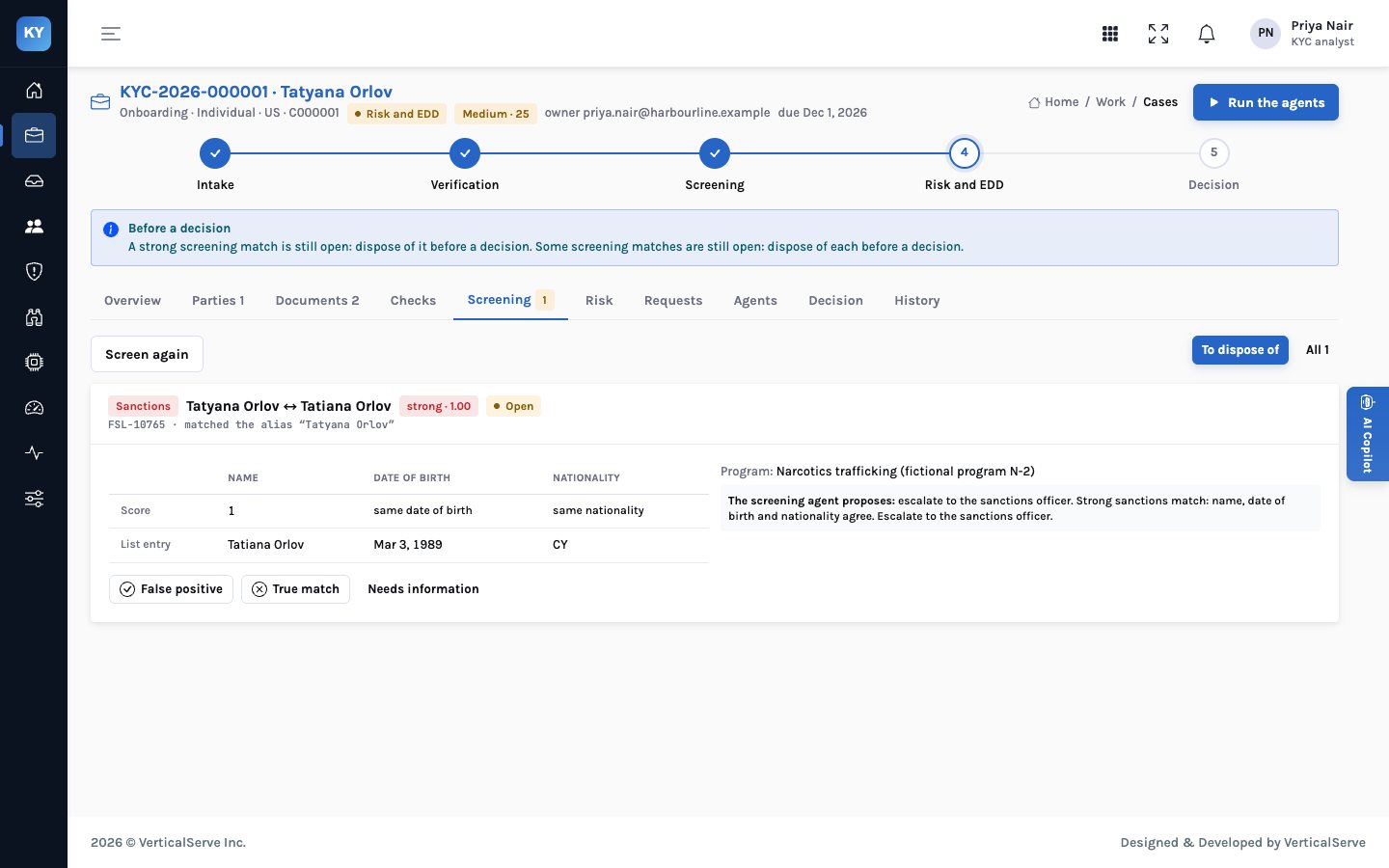
Tatyana Orlov applies for a personal account. Her name looks like nine entries on the sanctions list. Eight of them are other women called Tatiana, with different surnames and different birth years. One is Tatiana Orlov, listed under the alias “Tatyana Orlov”, born on 3 March 1989, a national of Cyprus. So is the applicant. That one is not a false positive, and the whole point of screening is to make sure it never gets cleared along with the other eight.
In short
- Most of a screening alert queue is people who merely share a name. The work is proving each one is someone else, quickly, with a reason a reviewer can check.
- Score the name, the date of birth and the nationality separately, and show all three. A single blended score hides exactly the evidence an analyst needs.
- Require the surname to agree. A shared first name on its own is not a match. In this case that rule alone keeps eight entries out of the queue.
- No agent clears a strong sanctions match. The screening agent proposes escalation. A person records the disposition, with a reason, and the case cannot be decided until they do.
The situation
The case is KYC-2026-000001 on InsightKYC’s demo data, an onboarding for an individual,
customer C000001, applying through the US business of the fictional Harbourline Bank. The
screening lists are invented for the demo: a fictional sanctions list of 1,160 entries, 500 politically
exposed persons and 130 adverse-media articles. The entry here, FSL-10765, sits on a
fictional programme, “Narcotics trafficking (N-2)”.
| List entry | Name on the list | Born | Nationality | Same person? |
|---|---|---|---|---|
| FSL-10765 | Tatiana Orlov (alias Tatyana Orlov) | 3 Mar 1989 | CY | Name, date of birth and nationality all agree |
| FSL-10327 | Tatiana Kozlov (alias Tatyana Kozlov) | 1964 | CY | Different surname, different birth year |
| FSL-10517 | Tatiana Fedorov | 19 Dec 1965 | CY | Different surname, different birth year |
| FSL-10393 | Tatiana Sokolov | 2 Dec 1953 | CY | Different surname, different birth year |
| FSL-10062 | Tatiana Kozlov | 14 Jan 1983 | RU | Different surname, year and nationality |
| … four more | Tatiana Morozov, Fedorov, Sidorov | 1957 to 2002 | RU, UA | Different surname, year and nationality |
Every one of the nine shares a first name with the applicant, in one spelling or the other, and a surname of the same Russian pattern. A matcher that compares whole names loosely will raise all nine. That is how screening queues fill up.
Why screening queues fill up
Name matching has to be fuzzy. Names are transliterated (Tatiana, Tatyana), reordered, abbreviated and misspelt, and a list entry may carry several aliases. A matcher strict enough to miss nothing will match a lot of people who are not on the list. The usual response is to tune the threshold down until the queue is bearable, which trades false positives for misses, the one error a sanctions programme can’t afford.
Why a miss is the expensive error
US sanctions administered by OFAC are enforced on a strict liability basis: a bank can be penalised for dealing with a sanctioned person even if it didn’t know. That is why the answer to noise can’t simply be a higher threshold. It has to be better evidence on each alert.
The better answer is to look at more than the name, and to show the analyst every part of the comparison, so that clearing a false positive takes seconds and a true match stands out.
How InsightKYC scores a match
Each party on the case is screened against the sanctions, PEP and adverse-media lists, including every alias. The score has three parts, each kept and shown:
| Part | How it is computed | What it means here |
|---|---|---|
| Name | Token-sort similarity on the normalised names, so word order doesn’t matter; a Jaro-Winkler comparison is used only when the token-sort score is already 0.85 or more; the surname must agree | Tatyana Orlov vs alias Tatyana Orlov: 1.00. Tatyana Orlov vs Tatiana Kozlov: the surnames disagree, so it is not a candidate |
| Date of birth | Same date, same year, different year, or unknown, each moving the score | Same date of birth: 3 March 1989 on both |
| Nationality | Same, different or unknown | Same: Cyprus |
The result is a strength: strong when name and secondary identifiers agree, possible, or weak when only the name is close. Names that are very close but whose dates of birth differ are still kept, as weak matches, rather than dropped, so a list entry with a wrong date on it can’t hide.
Nine look-alike entries. The surname rule removes eight before they become alerts; the ninth agrees on everything.
What the agent may and may not do
The screening agent runs the screen and, for each match, proposes a disposition with its reason: false positive, true match, needs information, or escalate. For a weak match with a different birth year and nationality it proposes “false positive” and says why. For a strong sanctions match it proposes only escalation.
| Match | The agent proposes | Who records the disposition |
|---|---|---|
| Weak: different surname or year | False positive, with the differences named | The analyst, accepting or changing it |
| Possible: name close, identifiers missing | Needs information | The analyst, usually after asking the customer |
| Strong sanctions match | Escalate to the sanctions officer. Never a clearance | A person, with a written reason; it blocks the decision until then |
A design rule, not a setting
Clearing a strong sanctions match is not on any autonomy dial. However much autonomy the agents earn elsewhere, this action is not one they can be given. Two case controls enforce it: OPEN_STRONG_HITS blocks approval while a strong match is open, and SANCTIONS_TRUE_MATCH blocks it once one is confirmed.
Who does what
The case cannot be approved while the strong match is open, and cannot be approved at all once it is confirmed.
Applicant, owners, directors and aliases against sanctions, PEP and adverse media. Each match is stored with its three-part score.
Name, date of birth and nationality side by side, with the customer’s passport fields one tab away, each quoted from its line.
A strong match goes to whoever your procedure names, with the comparison. Whoever disposes of it does so on the case, so the record shows who decided and when.
True match, or false positive with the specific difference that proves it. The reason is kept on the case and frozen into the decision record.
A confirmed match blocks approval. The decline records the reason; any report or asset freeze follows the bank’s sanctions procedure outside the case.
Clearing a false positive well
Most matches on a real book are false positives, and the quality of each clearance matters as much as the speed. A reviewer or examiner sampling the file should be able to see why each one was cleared.
Cleared with no reason, or a reason that just restates the outcome. A reviewer can’t tell whether anyone compared the identifiers.
Names the identifier that differs, both values, and the evidence. Anyone can check it in a minute.
InsightKYC asks for the reason in the dialog that records the disposition, and the placeholder shows the kind of reason that holds up. A disposition with an empty reason can’t be saved.
What it means for each audience
For the CCO & MLRO
Every disposition carries who, when and why, and the decision record freezes them as they stood at the decision. If a cleared match is questioned later, the evidence is on the file.
The rule that no agent clears a strong sanctions match is visible in the product, not just in a policy document.
For the KYC operations lead
The queue holds matches worth looking at. Look-alike names with a different surname never arrive, and the ones that do arrive show the comparison, so clearing a weak match is a minute’s work.
The time saved goes to the matches that need judgement.
For the board
The bank screens every party, including owners found in the registry, and can show why each match was cleared or escalated.
Sanctions exposure is measured in confirmed and open strong matches, not in alert counts.
What to be careful about
- The surname rule has limits. Some naming conventions don’t put the family name last, and some people change surnames. Aliases on the list help; so does screening on the name as it appears in the identity document. Test the rule against your own population before relying on it.
- Missing identifiers weaken everything. Many real list entries have only a birth year, or none. A match with no date of birth to compare is “possible”, not cleared.
- The demo lists are invented. A deployment screens against the bank’s own licensed or official lists, and the thresholds should be tuned and documented for them.
Screening isn’t about raising fewer alerts. It’s about never clearing the one that matters.
Show the name, date of birth and nationality on every match, ask for a reason on every clearance, and keep strong sanctions matches out of any agent’s reach.