The most common reason an onboarding file comes back from quality assurance is not a sanctions match or a hidden owner. It is a document that was out of date, or a proof of address that was too old, or a name that didn’t quite match. These are small findings, easy to miss when someone is reading fifty files a day, and every one of them is a defect an auditor will count.
In short
- Routine checks fail routinely. Expired identity documents, stale proofs of address and small name differences are the everyday defects of a KYC file.
- A check is only useful if it quotes its evidence. “ID expired” is a claim. “Line 8: EXP: 10/07/2026” is evidence the analyst can verify in seconds.
- The fix is usually a request, not a judgement. Ask the customer for a current document; when it arrives, read it and run the checks again.
- Waivers are allowed, and recorded. Where policy allows an exception, the analyst waives the check with a reason that stays on the decision record.
The situation
The case uses InsightKYC’s demo data for Harbourline Bank, a fictional bank. Jing Wang
applies for a personal account. Her file holds two documents: a State of Illinois driver’s
licence and a utility bill. The case opens as KYC-2026-000009 on 20 November 2026.
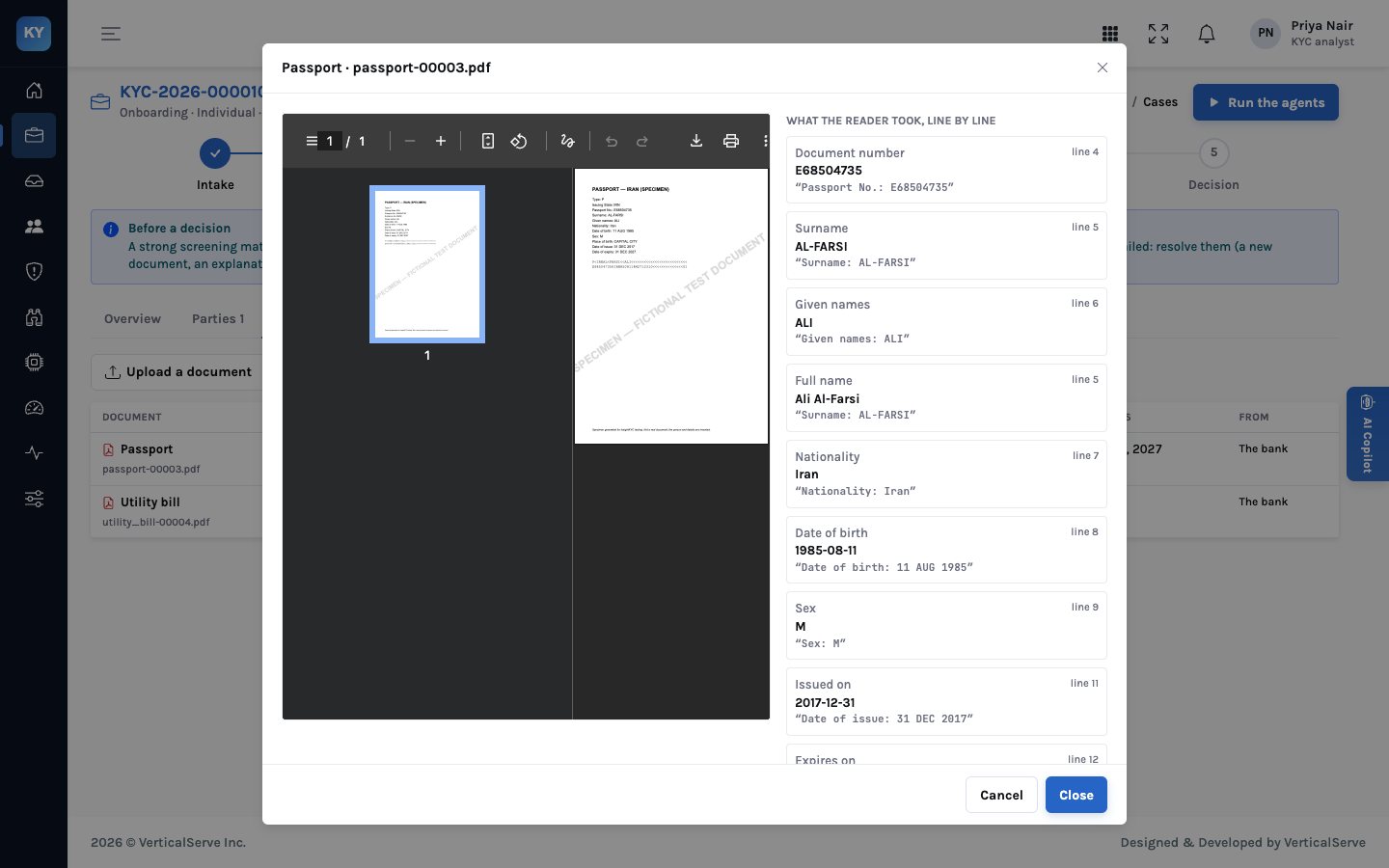
The document reader turns the licence into fields. Each is tied to the line it came from:
| Field | Value | Line | Quoted text |
|---|---|---|---|
| Issuing state | Illinois | 1 | STATE OF ILLINOIS — DRIVER LICENSE (SPECIMEN) |
| Document number | IL77062305 | 2 | DL NO: IL77062305 |
| Full name | JING WANG | 3 | NAME: JING WANG |
| Date of birth | 1998-11-26 | 5 | DOB: 11/26/1998 |
| Issued on | 2021-12-31 | 7 | ISS: 12/31/2021 |
| Expires on | 2026-10-07 | 8 | EXP: 10/07/2026 |
The licence expired on 7 October 2026, six weeks before the case was opened. The verification agent flags it, and the check carries the quote from line 8.
Why small defects slip through
A tired reviewer looks for the big things: is the photo plausible, is the name right, is there a sanctions hit. The expiry date is one small line on a card, and the calendar has moved on since the customer first sent the document. Files that sit waiting for other information are the most at risk: a document valid on the day of the application can expire before the decision.
- Expiry is relative to the decision date, not the date the document arrived. A check run once at upload goes stale.
- Proof-of-address recency has its own window, commonly a few months, set by the bank’s policy. The demo uses 90 days as an illustrative setting.
- Name comparisons are fuzzy: middle names, transliterations and order. A strict equality test fails good files; no test passes bad ones.
The reviewer glances at the licence on the day it arrives. When the case is decided weeks later, nobody looks again.
The checks run again whenever the agents run or a document arrives, against the current date, and each quotes the line it read.
How InsightKYC handles it
The loop closes itself: a new upload is read and the same check runs again.
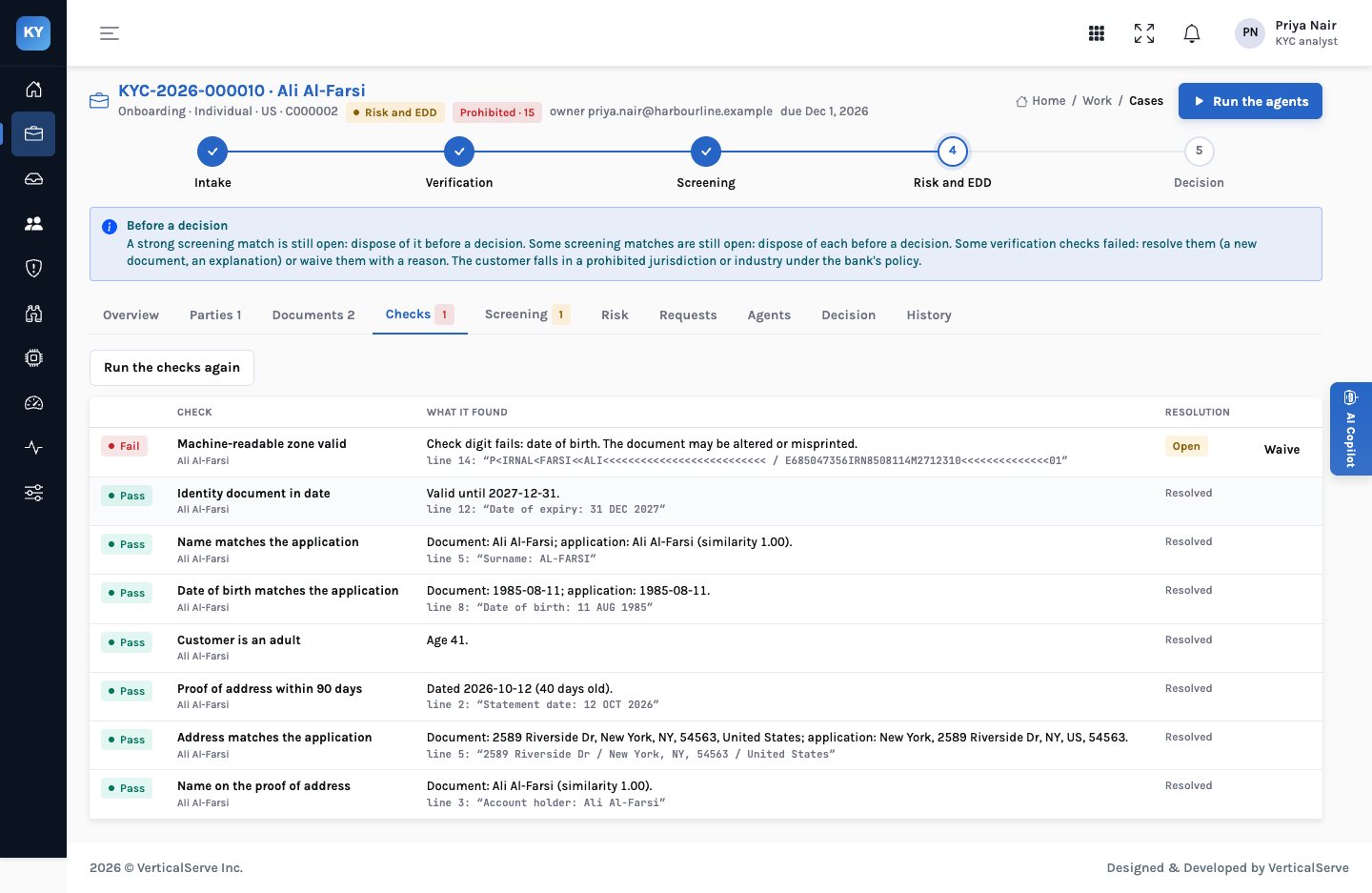
The identity checks run on every identity document on the case:
| Check | What it compares |
|---|---|
| Identity document present | At least one passport, national ID or driver’s licence for the person |
| Identity document in date | The expiry date read from the document against today |
| Name matches the application | A similarity score on the normalised names, with the score shown |
| Date of birth matches the application | The date read from the document against the application |
| Machine-readable zone valid | ICAO check digits, where the document has a zone |
| Customer is an adult | Age on the date of the check |
| Proof of address present and recent | A utility bill or bank statement within the policy window |
| Address and name on the proof of address | The address and account holder against the application |
Each failure is open until it is resolved: by a new document that passes, or by a waiver with a reason. Open failures block approval through the case controls in Rules Studio.
Who does what
The verification agent prepares the request. The analyst decides whether and when to send it.
Open the finding and read the quoted line. Confirm in the viewer that the reader took the right date.
Usually a request for a current document. If the customer has already supplied another valid ID, the check passes on that one instead.
Accept the verification agent’s drafted request, adjust it, and send. The link works only for this customer and this request.
When the new document arrives it is read, the checks run again, and a pass resolves the finding.
If the bank’s policy allows an exception, waive the check with the reason. The waiver and its reason are on the decision record.
The analyst’s choices
| Finding | Usual remedy | When a waiver might apply |
|---|---|---|
| Identity document expired | Request a current document | Rarely: only where the bank’s policy names an exception |
| Proof of address too old | Request a recent statement or bill | Where policy accepts another recent document already on file |
| Name differs slightly | Compare with a second document | A middle name or transliteration confirmed by another ID |
| Address differs | Ask whether the customer has moved | A documented recent move with the new address evidenced |
What it means for each audience
For the CCO & MLRO
Small defects are the ones quality assurance finds most often. A check that quotes its evidence and blocks approval until resolved turns a sampling finding into a control.
Waivers are visible, counted and attributed.
For the KYC operations lead
The analyst stops reading every date on every document. The checks do that; the analyst reads the failures, with the evidence already quoted.
The request to the customer is drafted before the analyst opens the case.
For the board
These are not headline risks, but they are the defects regulators cite when they say a bank’s files are incomplete.
Fixing them is cheap when it happens before the decision.
Metrics to track
What to be careful about
- The reader can be wrong. A misread date produces a false failure. The quote and the viewer are there so the analyst can see it in seconds.
- Windows are policy. The 90-day proof-of-address window in the demo is illustrative. Set the bank’s own.
- Specimen documents. The demo’s documents are generated specimens with a watermark. Real documents vary more in layout and quality.
- Don’t over-waive. A waiver that becomes routine is a policy change. Make it one, explicitly, or stop waiving.
The defects that fail files are rarely dramatic. They are dates.
Check them every time, against today, and quote the line. Then the analyst’s attention goes where judgement is needed.