Know-your-customer does not end at onboarding. A customer who declared modest salary deposits and starts paying in cash just under the reporting threshold, several times a week, is telling the bank something the application did not. Ongoing monitoring exists to notice. The hard part is what happens next: reading the alert properly, deciding whether it is a concern, and, if it is, reopening what the bank knows about the customer.
In short
- Structuring is itself an offence in the US. Breaking cash into amounts below the $10,000 currency transaction report threshold to avoid the report is prohibited by 31 U.S.C. 5324, whether or not the money is clean.
- An alert is a question, not a conclusion. Payroll, a seasonal business or a one-off sale can look like a pattern. The analyst closes it with a reason or escalates it.
- Escalation reopens KYC. In InsightKYC an escalated alert opens an event-driven review of the customer, with the alert and its transactions on the case.
- Reporting decisions stay with the bank’s procedure. Whether to file a suspicious activity report is decided by the people the bank designates, not by a monitoring rule or an agent.
The legal background, briefly
data
US banks must file a currency transaction report for cash transactions of more than $10,000 in a business day, and multiple cash transactions by or for the same person are aggregated. Structuring, meaning conducting transactions in a way designed to evade that requirement, is prohibited. Banks must also file a suspicious activity report for transactions of at least $5,000 that they know, suspect or have reason to suspect are designed to evade Bank Secrecy Act requirements.
Sources: 31 U.S.C. 5313 and 31 CFR 1010.311 (currency transaction reports); 31 CFR 1010.313 (aggregation); 31 U.S.C. 5324 (structuring); 31 CFR 1020.320 (suspicious activity reports by banks). Other countries have their own thresholds and rules.
The situation
The case uses InsightKYC’s demo data for Harbourline Bank, a fictional bank. Every transaction is generated. The monitoring agent reads the active customers’ transactions against what each declared at onboarding and runs five rules:
| Rule | What it looks for |
|---|---|
| Structuring | Cash deposits just under 10,000, several within 14 days |
| High-risk country | Payments to or from countries the bank rates high risk |
| Above profile | Monthly credits well above what the customer declared |
| Dormant reactivated | A quiet account that suddenly moves money |
| New country | Payments involving a country the customer did not declare |
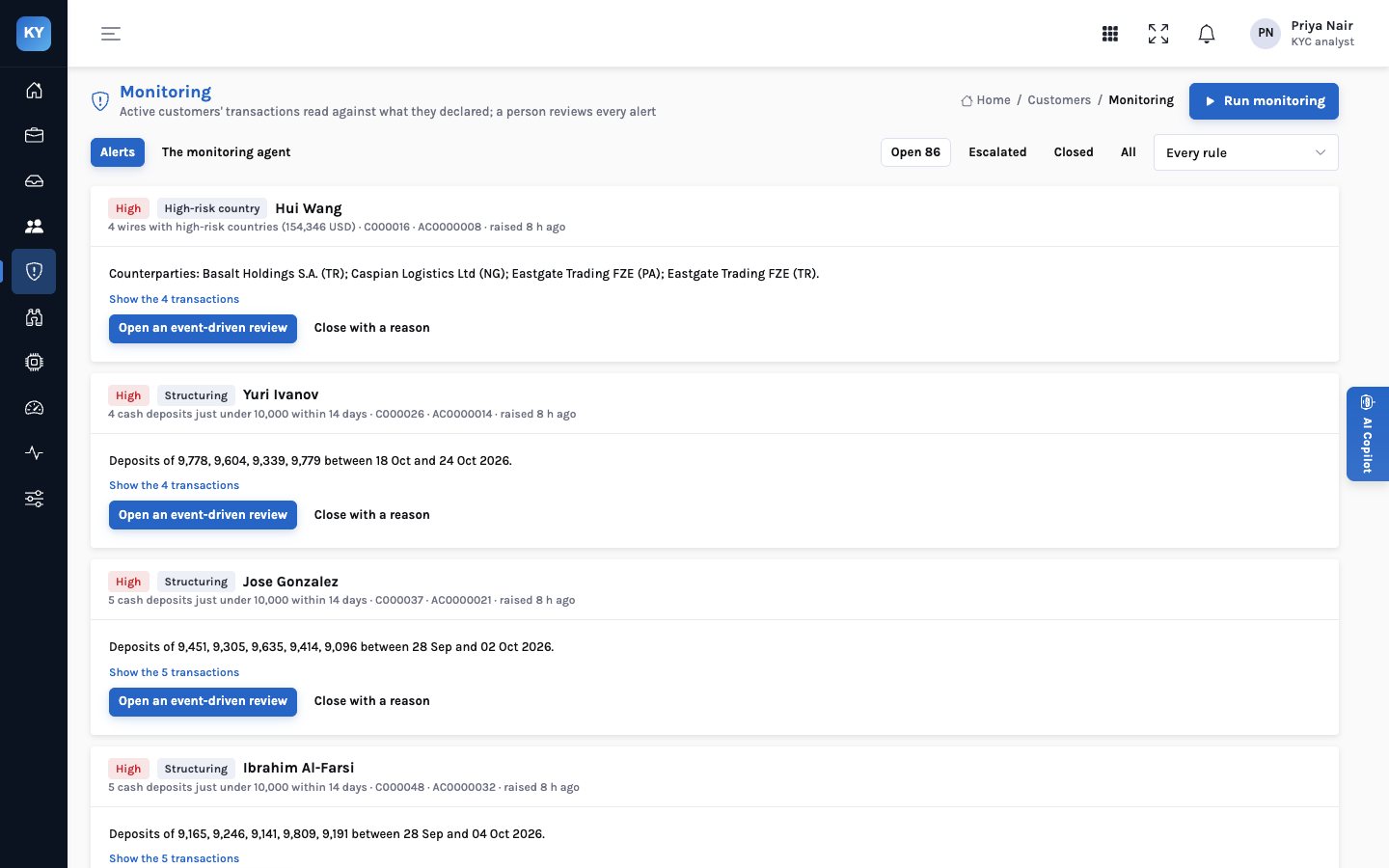
The first run read 383 accounts and raised 86 alerts, 24 of them high. Two of the structuring alerts:
| Customer | Deposits | Window |
|---|---|---|
| Jose Gonzalez (C000037, account AC0000021) | Five cash deposits: 9,451, 9,305, 9,635, 9,414 and 9,096 | 28 September to 2 October 2026 |
| Yuri Ivanov (C000026, account AC0000014) | Four cash deposits: 9,778, 9,604, 9,339 and 9,779 | 18 to 24 October 2026 |
Each deposit on its own is unremarkable. Together, five cash deposits in five days that each stop a few hundred short of 10,000 add up to 46,901. The pattern, not any single amount, is the concern.
Why alerts pile up
Monitoring systems are tuned to catch, so they raise more alerts than there are true concerns. The cost is in the reading. An analyst who sees only “structuring, high” has to open the core banking system, pull the transactions, find the customer’s profile in the KYC file and decide. When the decision is to close, the reason is often a one-word note. When it is to escalate, the KYC file and the alert stay in different systems.
The analyst pulls the transactions and the customer profile from two other systems, then writes “reviewed, no concern” or forwards an email.
The alert carries the transactions it found, the counterparties and countries, and the customer’s declared profile. Closing needs a reason; escalating opens a review case.
How InsightKYC handles it
An alert ends in one of two places: closed with a reason, or a review of the customer.
The alert shows the transactions that triggered it. For a high-risk-country alert, it lists the counterparties and countries; for structuring, each deposit with its date, amount and channel. The analyst reads them in place.
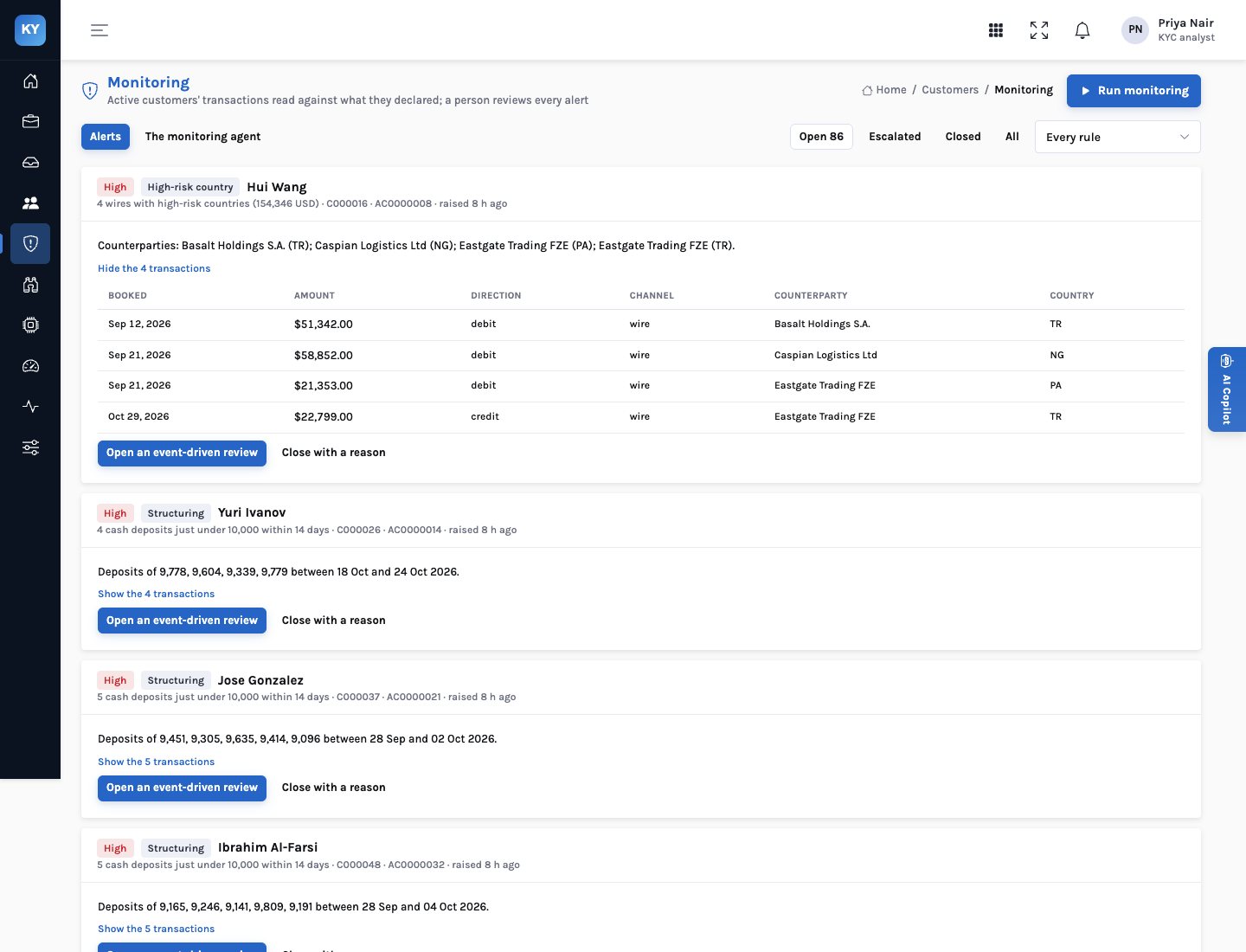
Closing an alert requires a reason, written by the analyst: “payroll from a new employer; matches the declared occupation”. The reason and the analyst’s name stay on the alert. Escalating opens an event-driven review: a KYC case on the customer whose trigger is the alert. The agents run on it like any other case. The EDD agent can prepare a request asking the customer to explain the source of the cash; the analyst sends it if they choose.
Who does what
Monitoring and the review are InsightKYC’s. Whether to report is the bank’s procedure, run by the people it designates.
Dates, amounts, channels and branches. How close to the threshold, how many, over how long.
Occupation or business, expected monthly credits and cash share. A cash-heavy business that declared it is different from a salaried customer.
A reason that names the fact that explains it, or an event-driven review.
Follow the bank’s procedure. Neither the rule nor an agent decides whether to file.
Re-screen, re-rate with the new facts, and decide whether to ask the customer about the source of the cash, mindful of tipping-off rules.
Keep, keep with restrictions or more frequent review, or exit. The decision record keeps the alert and the evidence.
The analyst’s choices
| What the facts show | Reasonable outcome | What goes on the record |
|---|---|---|
| A cash-intensive business that declared a high cash share | Close, or tune the rule for this segment | The declared profile and why the pattern fits it |
| A one-off, documented sale of an asset | Close with the evidence noted | The explanation and where it is evidenced |
| A salaried customer with repeated deposits just under the threshold | Escalate; refer under the procedure | The review case, the referral and the analyst’s reasoning |
| The same pattern across several linked customers | Escalate each; flag the link | The linked alerts and the cases they opened |
What it means for each audience
For the CCO & MLRO
Every closed alert has a reason and a name, and every escalation becomes a review with its evidence. That is what an examiner samples.
The reporting decision remains with the designated officer, outside the agents’ reach.
For the KYC operations lead
The analyst sees the transactions and the profile together and spends time deciding, not gathering. Escalation is one click and produces a case, not an email.
Rule-by-rule outcomes show which rules need tuning.
For the board
Ongoing monitoring is where KYC meets financial crime. The question for the board is whether alerts are worked on time and whether escalations change anything.
Both have answers in the record.
Metrics to track
What to be careful about
- Tipping off. Asking a customer about the source of cash is ordinary due diligence; revealing that a suspicious activity report is being considered is not allowed. Follow the bank’s procedure on what to ask and how.
- Thresholds differ by country. The demo’s rule uses 10,000 because the bank is fictional and US-like. Set rules to the regimes the bank operates under.
- Rules are a starting point. Five rules on generated data are a demonstration, not a transaction monitoring programme. A bank’s own scenarios, tuned and validated, take their place.
- Don’t close by volume. A reason like “reviewed” is not a reason. Make the reason name the fact.
An alert is the moment the customer stops matching what they told you.
Read it with the profile beside it, close it with a reason that names a fact, or reopen what you know about the customer.