Ask a head of KYC operations how they handled last year’s growth and the answer is usually a headcount number. More applications meant more analysts. A new sanctions programme meant more screening reviewers. A remediation finding meant a temporary team of contractors working through the back book. Each answer was reasonable on its own. Together they describe a function that grows in a straight line with the business, and gets slower anyway.
In short
- KYC scaled by adding people, so its cost grows with volume. Every new application, alert and periodic review needs an analyst’s time, and most of that time goes on gathering and checking, not on judgement.
- The judgement is a small part of each case. Reading a passport, walking an ownership chain or clearing a namesake is preparation. Deciding whether to take the customer is the part that needs a person.
- Speed and control pull against each other in the old model. Faster onboarding usually meant thinner files; better files usually meant slower onboarding.
- The fix is to separate preparation from decision. Let software prepare the case, with every fact cited to its source, and keep the decision, and the record of it, with people.
How KYC grew
Know-your-customer started as a short list of things to collect: an identity document, an address, a signature. Over two decades the list grew. The FATF Recommendations set out customer due diligence as identifying and verifying the customer, identifying the beneficial owner, understanding the purpose and intended nature of the relationship, and keeping the picture up to date (Recommendation 10). Politically exposed persons need extra measures (Recommendation 12). Companies and trusts have to be seen through to the people behind them (Recommendations 24 and 25). National rules turned each of these into obligations a bank is examined against.
None of that is controversial. The difficulty is in how the work was organised to meet it. In most banks the unit of work is the case, and the unit of capacity is the analyst. A case arrives, an analyst opens six systems, gathers what they can, checks it by eye, writes a note and passes it on. When volume rises, the bank hires.
The traditional case: four steps of preparation, all done by hand, before the one step that needs judgement.
Where the analyst’s day actually goes
Watch an experienced analyst work a business onboarding case and count the minutes. A small part goes on the question the case exists to answer: should the bank take this customer, at what risk rating, with what conditions? Most of it goes on assembling the facts that answer depends on.
| Activity | What it involves | Needs judgement? |
|---|---|---|
| Reading documents | Typing names, dates, numbers and addresses from passports, utility bills and certificates into the case | Rarely: only when a document is unclear |
| Comparing | Does the name on the passport match the application? Is the bill recent? Is the address the same? | Rarely: the comparison is mechanical |
| Ownership | Pulling registry extracts, following each holding company, multiplying percentages down the chain | Sometimes: when the structure is unusual |
| Screening | Reviewing every possible match against sanctions, PEP and adverse-media lists, most of them namesakes | Yes, for the real candidates; no, for the obvious misses |
| Chasing the customer | Writing to ask for what is missing, then waiting, then re-checking what arrives | Rarely: the gaps are already known |
| Writing it up | Summarising all of the above in a memo the approver can read | Partly: the conclusion is judgement, the summary is not |
| Deciding | Accept, decline, or accept with conditions and a review date | Always |
The pattern is the same in every bank we talk to, even if nobody has measured it precisely: the activities that need judgement are the minority, and they wait behind the ones that do not. If you want to know the split in your own operation, the business case post sets out how to measure it.
Three ways the model breaks
1. Cost grows with volume
When every case needs the same manual preparation, the cost of KYC is roughly the number of cases times the minutes per case. Growth in a product line, a new market or a regulatory remediation all land on the same queue. The bank either hires, outsources or lets the backlog grow.
2. Quality depends on the person
Two analysts given the same file will not always reach the same risk rating, find the same holding company or clear the same namesake for the same reason. Procedures and checklists help. They do not remove the variation, because the work is done by eye and written up in free text. Examiners notice inconsistency long before they notice any single mistake.
3. The record is thinner than the work
An analyst may have checked the MRZ on a passport, compared three addresses and reasoned carefully about why a match was a false positive. What survives in the file is often a tick and a sentence. When the customer is reviewed two years later, or a regulator asks why the bank accepted them, the reasoning has to be reconstructed.
Each analyst gathers, checks, screens and writes. Capacity is headcount; quality is the person; the file records the outcome but not the reasoning.
Software gathers, checks, screens and drafts, citing each fact to its source. The analyst reviews what was prepared and decides. The file holds both.
Why earlier automation didn’t fix it
Banks have automated parts of KYC for years. Screening engines, document capture, registry feeds and case-management systems are all common. They helped at the edges and left the shape of the work alone, for three reasons.
- Each tool did one step. A screening engine produced alerts; a document tool produced images; a registry feed produced extracts. The analyst was still the integration layer, carrying facts from one screen to the next.
- Outputs were not explained. A match score of 87 or a risk rating of “medium” with no reasons forces the analyst to redo the work to trust it.
- Rules were tuned for safety, not precision. When the cost of a miss is a sanctions breach, thresholds go low and alert volumes go high. The volume lands on analysts.
What changed
Language models can now read an unfamiliar document and say which line each value came from. Registry data can be walked automatically. Matching can be scored on several identifiers and explained in a sentence. None of these is new on its own. What is new is that one case can be prepared end to end, with the evidence attached, before a person opens it.
Separating preparation from decision
The change we argue for is organisational before it is technical. Treat every case as two jobs: preparing it, and deciding it. Preparation can be done by software, provided every fact it produces carries its source and every conclusion carries its reasons. Decision stays with people, and the record of the decision captures what they saw.
Two jobs, one case. The agents never cross into the right-hand box.
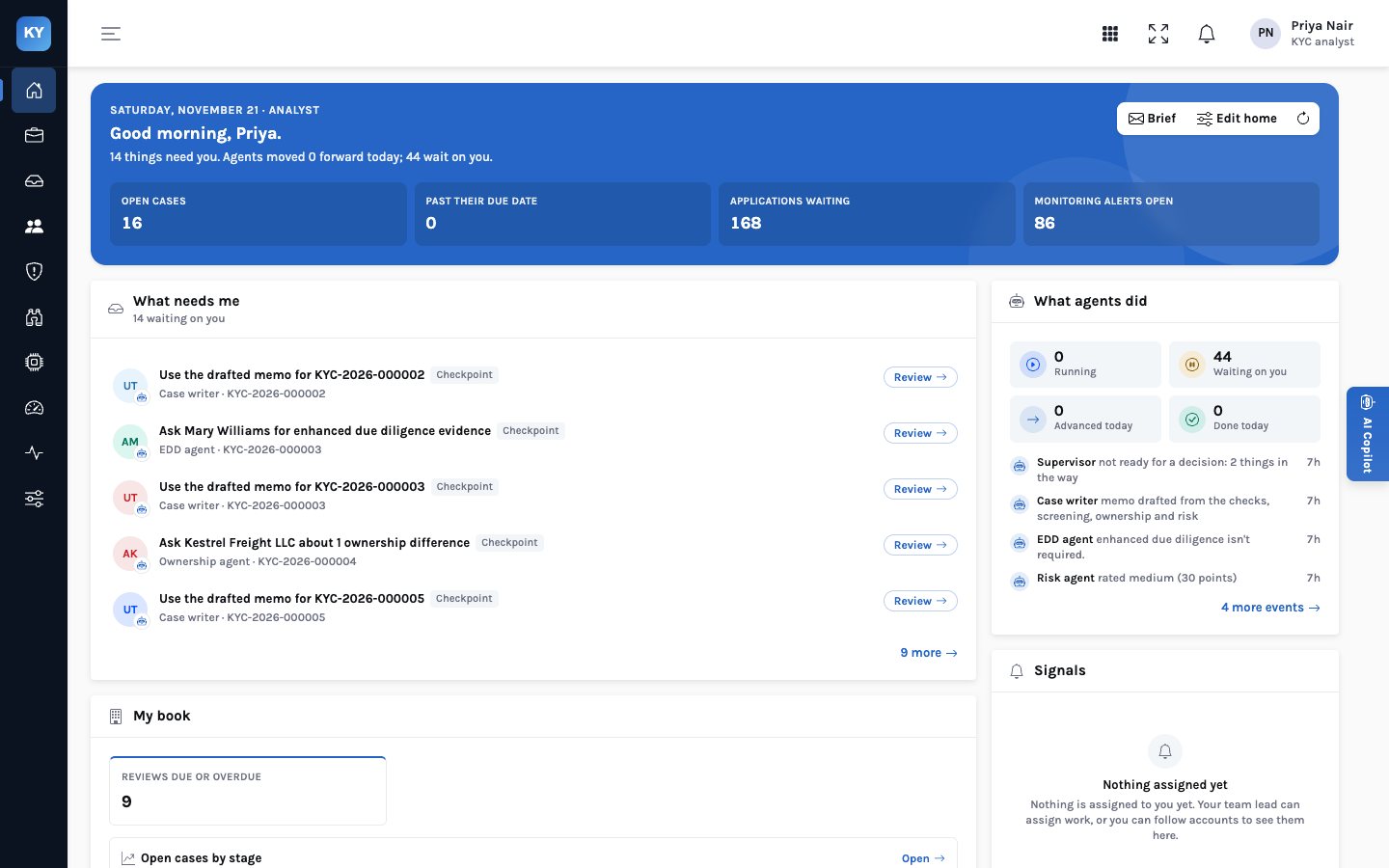
This is how InsightKYC is built. On a case, ten agents read the documents, walk the company registry, run the checks, screen the parties, rate the risk and draft the memo. Each one is capped at preparing work for a person: none of them can clear a sanctions match, waive a failed check, send a message to the customer or approve a customer. The analyst sees what was prepared, with the line each value was read from, and decides.
What it means for each audience
For the CCO & MLRO
The question shifts from “how many analysts do we need?” to “how many decisions do we need people to make, and are they making them well?”
Consistency improves because the preparation is the same every time, and the decision record shows the evidence, not just the outcome.
For the KYC operations lead
Analysts stop being the integration layer between six systems. Their queue becomes a list of prepared decisions with the reasons attached.
New starters become productive faster because the case already shows what was checked and why.
For the board
KYC cost stops growing in a straight line with the business. Onboarding time becomes something the bank can manage rather than accept.
The control environment gets stronger at the same time, which is the opposite of the usual trade-off.
What to be careful about
- Prepared is not decided. If analysts start accepting everything an agent prepares without reading it, the bank has automated the decision by the back door. Track how often people disagree with what was prepared; zero is a warning sign, not a success.
- Evidence or nothing. A value without a source should not appear in a case. An agent that cannot find something should say so, not fill the gap.
- The policy is still yours. Risk factors, thresholds and prohibited jurisdictions are the bank’s decisions. Software applies them consistently; it does not choose them.
KYC did not stop scaling because the rules got harder. It stopped scaling because people were doing the preparation.
Give the preparation to software that shows its sources, and give your analysts back the decisions.