The fastest way to fail with KYC automation is to switch it on for the whole onboarding book on day one. The second fastest is to run a pilot so cautious that it never produces a number anyone trusts. This is a ninety-day plan between the two: one product line, real cases, the bank’s own policy, people deciding every case, and a measured answer at the end about whether to go further.
In short
- Days 1–30: connect and configure. Read-only access to the source systems, the bank’s own risk methodology and case controls, roles, and a baseline measured before anything changes.
- Days 31–60: one case type, live. Agents prepare every case in one product line; analysts decide every case; a sample is worked both ways; calibration issues are fixed as they appear.
- Days 61–90: widen and decide. Add a second case type, usually periodic reviews, put validation evidence in front of model risk, and take a measured recommendation to the committee.
- Autonomy does not rise in ninety days. Agents prepare; people decide throughout. What the pilot earns is evidence, not permission.
Before day one: choose the scope
Pick one product line and one case type to start. A good first scope has enough volume to produce a measurement in a few weeks, a process the team knows well, and a risk profile that is not the bank’s most complex. Business onboarding in a commercial segment is a common choice because it exercises documents, ownership and screening together; individual onboarding is simpler and faster to measure.
| Decide up front | Why it matters |
|---|---|
| The product line and case type | Everything else is sized from it |
| Who decides cases during the pilot | Named analysts and leads; the same people throughout, so agreement rates mean something |
| The sample worked both ways | A fixed share of cases prepared by hand as well, to compare outcomes |
| What success means | Agreement, quality and time thresholds agreed before the pilot, not after |
| The exit | What happens to cases in flight if the pilot stops |
The plan
Ninety days, four tracks. People decide every case throughout.
Connect and configure
- Read-only access to the application system, customer data, document store, company registry and screening lists
- Analysts, leads and auditors set up with the right roles; leads are the only ones who can approve high-risk cases
- The bank’s risk factors, thresholds, prohibited jurisdictions and ownership threshold entered as settings and signed off
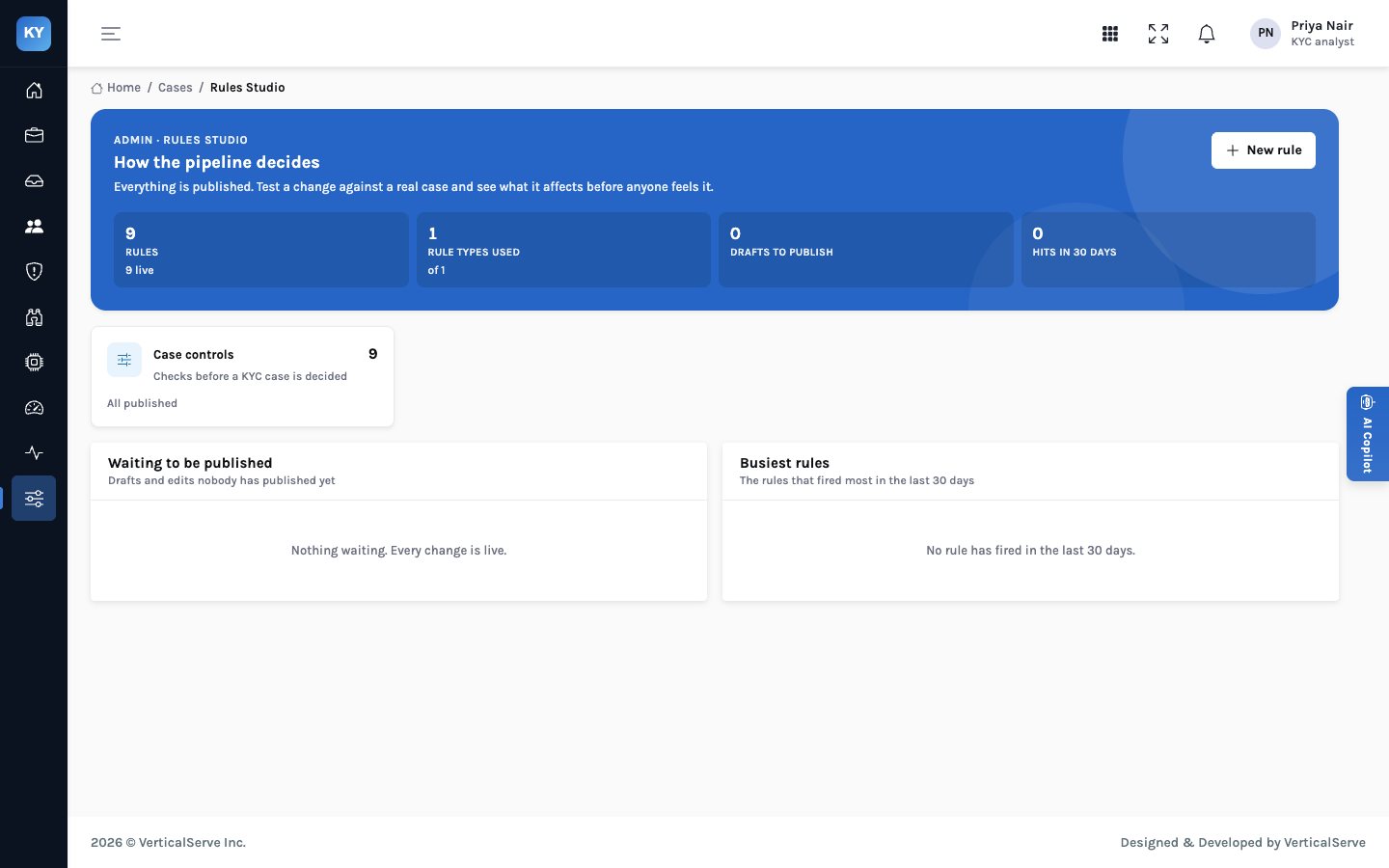
- Case controls (what blocks a decision, what refers it) written and published in Rules Studio
- Baseline: days to decision, minutes per case, QA return rate, overdue reviews
One case type, live
- Agents prepare every case in the chosen line; analysts review and decide every one
- A sample worked both ways and compared
- Agreement tracked per agent and per action: accept, reject, ask
- Calibration issues logged, fixed and re-tested against the known scenarios
- Customer requests drafted by agents and sent by analysts
Widen and decide
- Periodic reviews opened from the customer book for the same line
- Monitoring alerts read by analysts, closed with reasons or escalated to reviews
- Validation pack for model risk: design, test results, agreement, QA
- A recommendation to the committee with measured numbers
Days 1–30: connect and configure
Connect, read-only
The preparation layer needs to read what an analyst reads today. Keep every connection read-only; the source systems stay the source. InsightKYC reads applications, customers, related parties, the company registry, documents, screening lists, accounts and transactions, and writes only to its own case store.
Put the policy in, as the bank wrote it
This is the step most often rushed. The risk methodology, the prohibited jurisdictions and industries, the ownership threshold, the review cycles by rating and the case controls are the bank’s decisions, and they should be entered from the written policy and signed off by its owner. The values in our demo are illustrative; none of them should survive into a real deployment by default.
Measure the baseline
Before a single case is prepared, record the numbers you will compare against: median days from application to decision, analyst minutes per case by activity, QA return rate and overdue reviews. The business case post describes a simple time sample.
Days 31–60: one case type, live
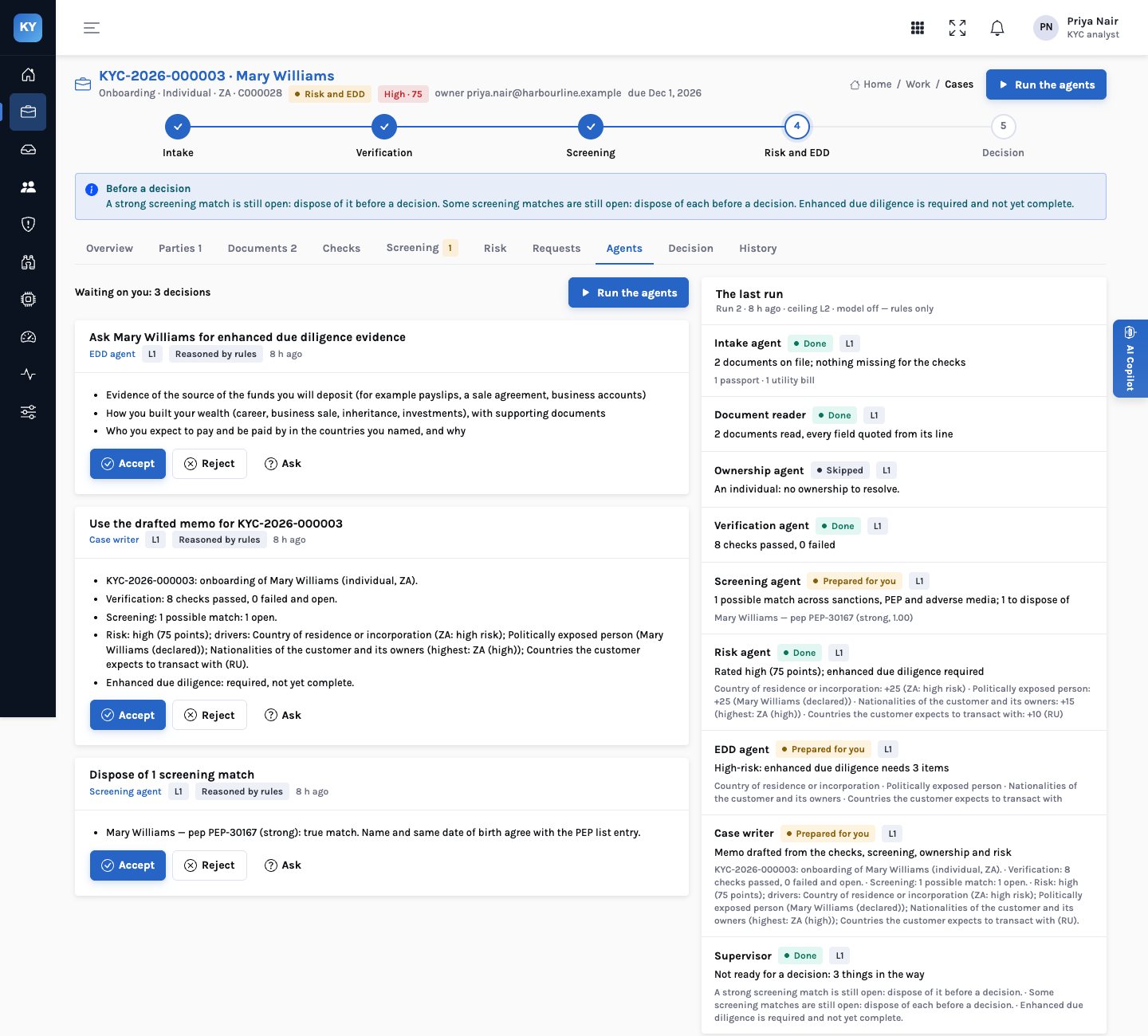
Now the agents prepare every case in scope. Nothing changes about who decides: the analyst reviews what was prepared, disposes of screening matches, resolves or waives checks with reasons, and decides; high-risk and PEP cases go to a lead who did not submit them.
Expect calibration
Every deployment finds something to tune in the first weeks: a document layout the reader does not know, a namesake pattern that produces noise, a risk factor that fires more often than the policy owner expected. Log each one, fix it, and re-run the known scenarios to prove nothing else moved.
An example from our own demo
When we first ran InsightKYC on its fictional bank, the screening matched customers to list entries that shared only a first name: “Tatyana Orlov” was proposed against several “Tatiana” entries with different surnames. We changed the matcher to require the surnames to agree, re-ran the planted scenarios (the true matches were still found), and the noise went away. That is the shape of calibration: specific, tested, and recorded.
Watch agreement, both ways
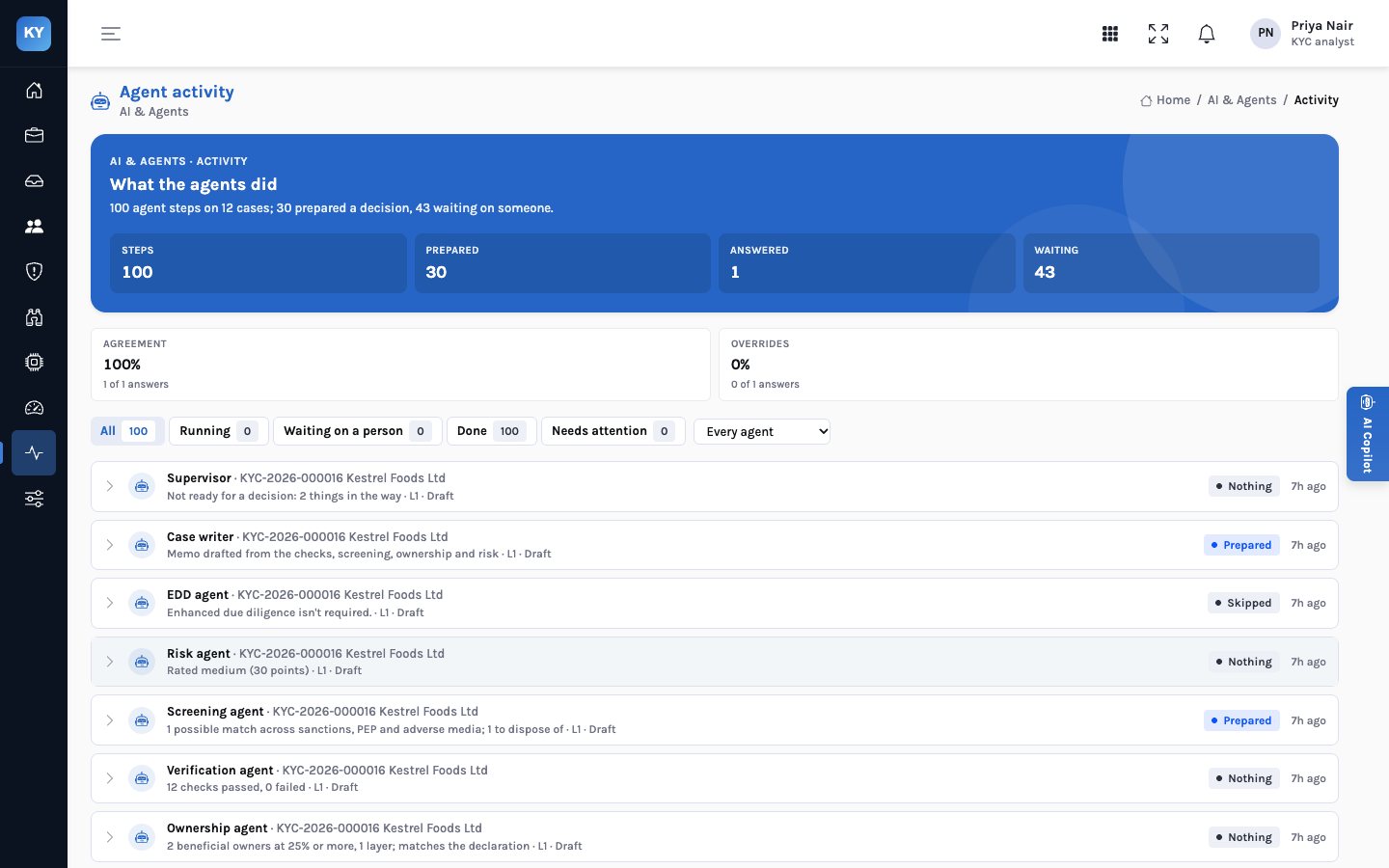
Agreement rates per agent tell you where the preparation is trusted. Low agreement on one action points to a calibration problem. Agreement close to 100% everywhere deserves a QA sample of its own, to check that analysts are reviewing rather than clicking.
Days 61–90: widen and decide
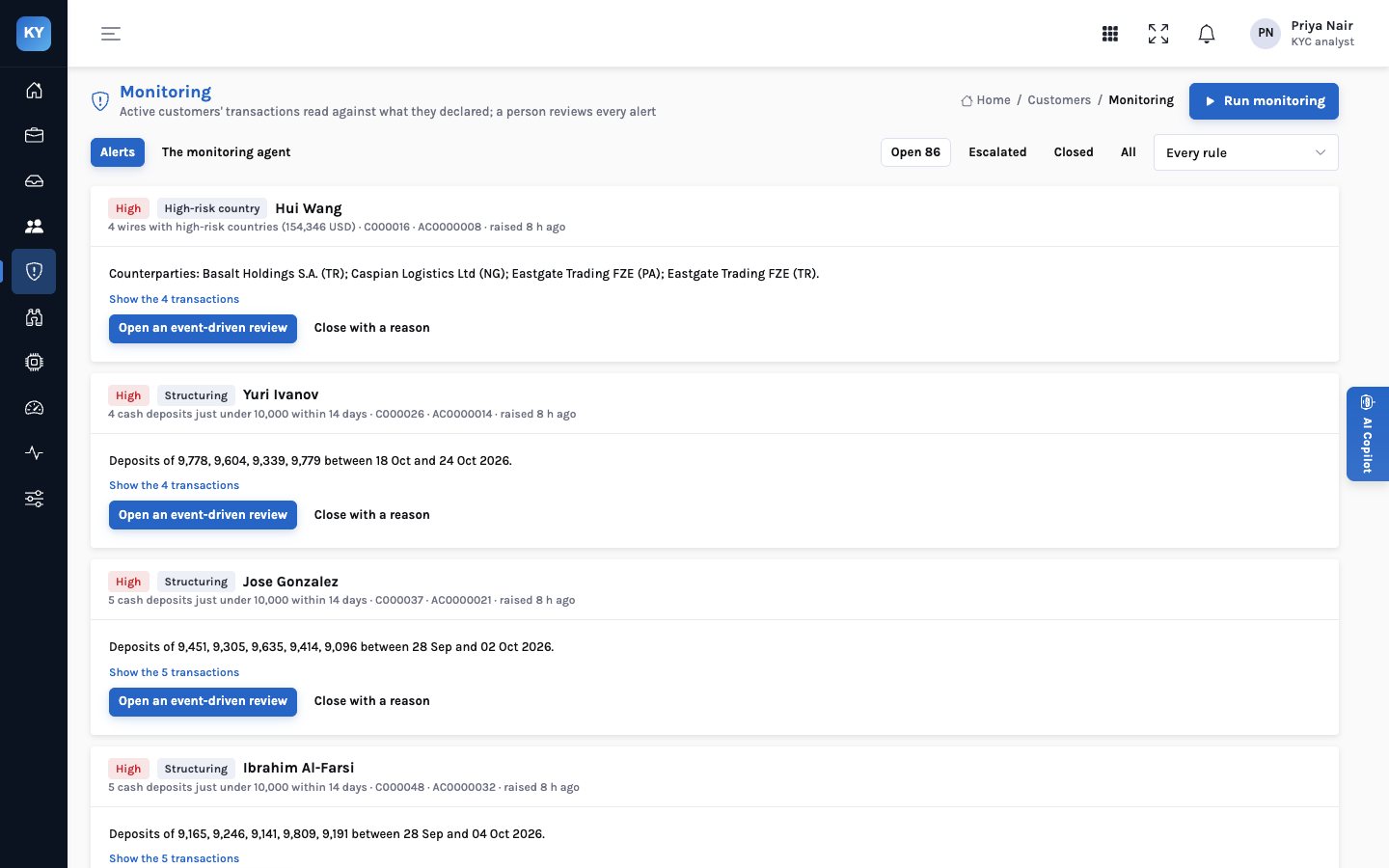
With one case type stable, add a second. Periodic reviews are a natural next step: the customer book already knows each customer’s rating and next review date, and a due review opens a case the same agents prepare. Ongoing monitoring can be switched on at the same time, with every alert read by a person and either closed with a reason or turned into an event-driven review.
The validation pack
Model risk will want to see the design of each engine, the results against known scenarios, the calibration log, agreement rates and QA results. If these were collected as the pilot ran, the pack is an export, not a project.
What to report at day 30, 60 and 90
| Day | Report | Decision it supports |
|---|---|---|
| 30 | Systems connected; policy entered and signed off; baseline numbers | Go live for one case type |
| 60 | Cases prepared and decided; agreement by agent and action; the both-ways sample compared; calibration log | Continue, fix or stop |
| 90 | Measured days to decision and review minutes against the baseline; QA results; validation pack; second case type running | Scale to more lines, and whether to consider any change in autonomy |
What it means for each audience
For the CCO & MLRO
Own the policy inputs and the success criteria. The pilot tests whether the platform applies your policy, not whether you like its defaults.
Keep four eyes and the decision record unchanged throughout; they are the control that makes the pilot safe.
For the KYC operations lead
Pick analysts who will disagree with the agents when they should. Their rejections and questions are how calibration happens.
Log every calibration change with the scenario that proved it.
For the board
Ninety days buys a measured answer, not a transformation. Ask at day 90 for the numbers against the baseline and the validation evidence.
Raising autonomy is a separate decision, taken later, on evidence.
In the first ninety days, the agents earn trust by preparing cases. People keep deciding them.
Start narrow, measure honestly, fix what you find, and scale on evidence.