Sooner or later, someone from the bank’s supervisor will sit down with the head of financial crime and ask about the AI in onboarding. It will not be a hostile question. Supervisors have said for years that new technology can make anti-money-laundering controls more effective. But they will want to know what the AI does, who checks it, and what happens when it is wrong. The banks that answer easily are the ones that designed for the question from the start.
In short
- Supervisors are not against AI in KYC; they are against unexplained AI. FATF has written about the opportunities new technology offers AML/CFT; model risk guidance asks that those tools be understood, validated and governed.
- The first question is what the AI decides. A tool that prepares work for a person sits very differently, in model risk and in data protection law, from one that accepts or declines customers on its own.
- Every output needs a source. A value read from a document should say which line it came from; a conclusion should say which facts it rests on.
- Autonomy should be earned and capped. Measure how often people agree with what the AI prepared, and let that evidence, within a ceiling the bank sets, decide how much it may do.
The frameworks a supervisor will reach for
There is no single rulebook for AI in KYC. A supervisor will draw on several existing ones.
| Framework | Where it applies | What it brings to the conversation |
|---|---|---|
| SR 11-7 / OCC Bulletin 2011-12, Supervisory Guidance on Model Risk Management | US banks | What counts as a model; effective challenge; validation of conceptual soundness, ongoing monitoring and outcomes analysis; inventory and governance |
| Interagency Statement on Model Risk Management for Bank Systems Supporting BSA/AML Compliance (2021) | US banks | Clarifies that the guidance is applied on a risk basis to BSA/AML systems, and that not every such system is a model |
| PRA Supervisory Statement SS1/23, Model risk management principles for banks | UK banks | Model identification, governance, development, validation and risk mitigants, explicitly including AI and machine-learning techniques |
| EU AI Act, Regulation (EU) 2024/1689 | Providers and deployers of AI in the EU | Risk categories; obligations for high-risk systems such as risk management, data governance, logging, transparency and human oversight |
| GDPR Article 22 | Personal data of people in the EU and UK | Limits on decisions based solely on automated processing that significantly affect a person |
Is KYC “high-risk” under the AI Act?
The AI Act’s list of high-risk uses in financial services centres on creditworthiness assessment and credit scoring of natural persons, and on risk assessment and pricing in life and health insurance. Customer due diligence for AML purposes is not named in that list as such. That does not end the question: a KYC tool that also feeds a credit decision may be in scope, and the obligations are staged over several years, with proposals to adjust the timetable. Check the current position with counsel rather than relying on a summary, including this one.
Question 1: what does the AI actually decide?
This is the question that shapes every other answer. There is a large difference between a tool that prepares a case for an analyst and one that decides it.
It accepts or declines customers, clears screening matches or sets risk ratings with no person in the loop. Model risk is high; Article 22 GDPR may be engaged; every error is the bank’s decision.
It reads, checks, screens and drafts; an analyst reviews and decides; the decision record shows both. The AI is a preparation tool whose output is challenged on every case.
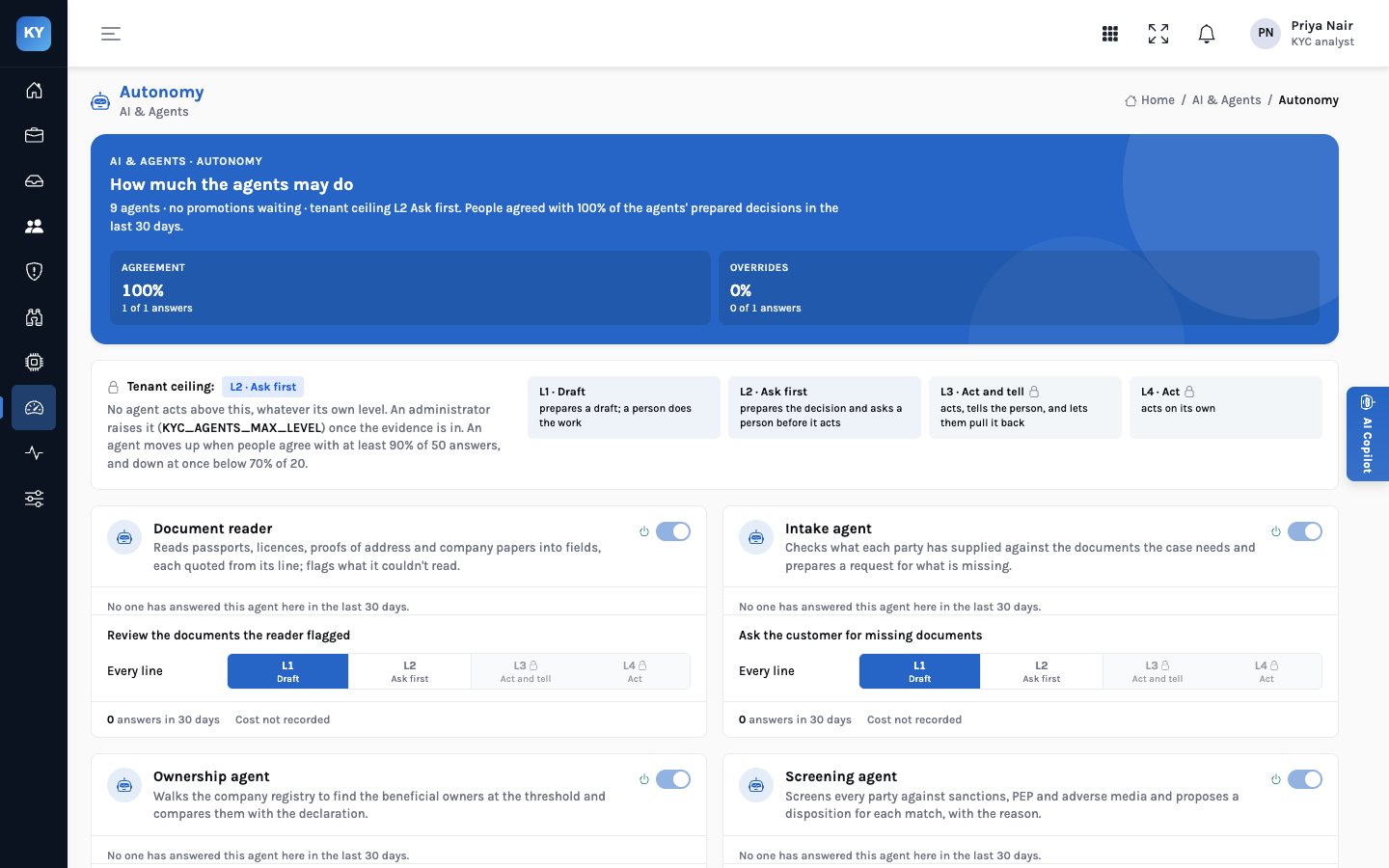
InsightKYC takes the second design, and enforces it. Its agents are capped by a tenant-wide ceiling (in the demo, L2, “ask first”): they can prepare a decision and ask a person to accept it, but cannot act alone. Some actions are outside any agent’s reach at any level: clearing a sanctions match, waiving a failed check, sending a message to a customer and approving or declining a customer are always a person’s.
Question 2: where did each fact come from?
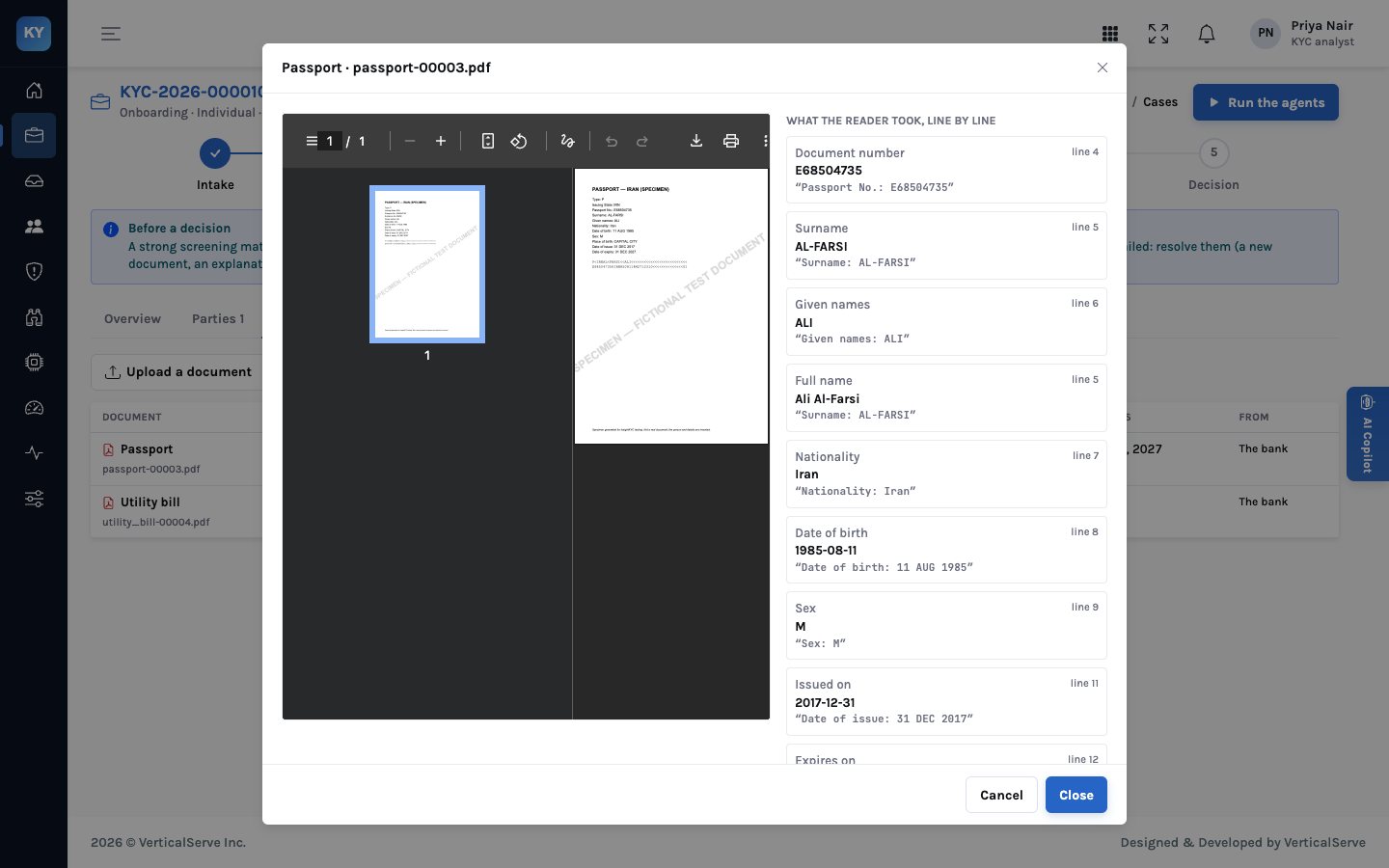
A supervisor will pick a case and ask how the AI reached a value. “The model read it” is not an answer. The answer should be a document, a page and a line, or a registry entry, or a list entry, with the rule that turned it into a conclusion.
- Extraction should quote. Every field read from a document in InsightKYC carries the line it came from and the text of that line.
- Calculation should be code. MRZ check digits, ownership percentages down a chain, screening scores and risk points are deterministic code with tests, not model output. The model is never asked to do arithmetic.
- Language should be grounded. When a model drafts a memo or a request, each statement must rest on facts already on the case. A draft that introduces a fact or figure not in the case is rejected and the agent falls back to its rules.
Question 3: how do you know it works?
Model risk guidance asks for validation before use and monitoring after. For a KYC preparation tool, that translates into three kinds of evidence.
A test set with planted scenarios (a hidden owner, a tampered MRZ, a true sanctions match among namesakes, an expired document) and proof that each is found. InsightKYC’s demo data is generated with a table of the scenarios planted in it for this purpose.
A written description of each engine: how names are compared, how ownership is calculated, how risk points are assigned, and why.
How often analysts accept, reject or question what each agent prepared, by agent and by action. A sudden change is a signal; so is perfect agreement.
Quality-assurance sampling of decided cases, including ones where the analyst followed the agent, to check the preparation was right.
Question 4: is the human review real?
A design where people approve whatever the AI prepares is automated decision-making with an extra click. Supervisors know this, and will ask how the bank prevents it. Useful answers:
- The review has something to review. Show the analyst the evidence and the reasons, not just a recommendation, so disagreeing is possible.
- Disagreement is easy and recorded. Accept, reject and ask are equal choices; each answer is kept on the decision record with any note.
- The highest-risk decisions get two people. Four eyes for high-risk and PEP customers, enforced by the system rather than by procedure.
- Agreement is monitored. An analyst who accepts everything is visible in the numbers.
Question 5: what happens when it fails?
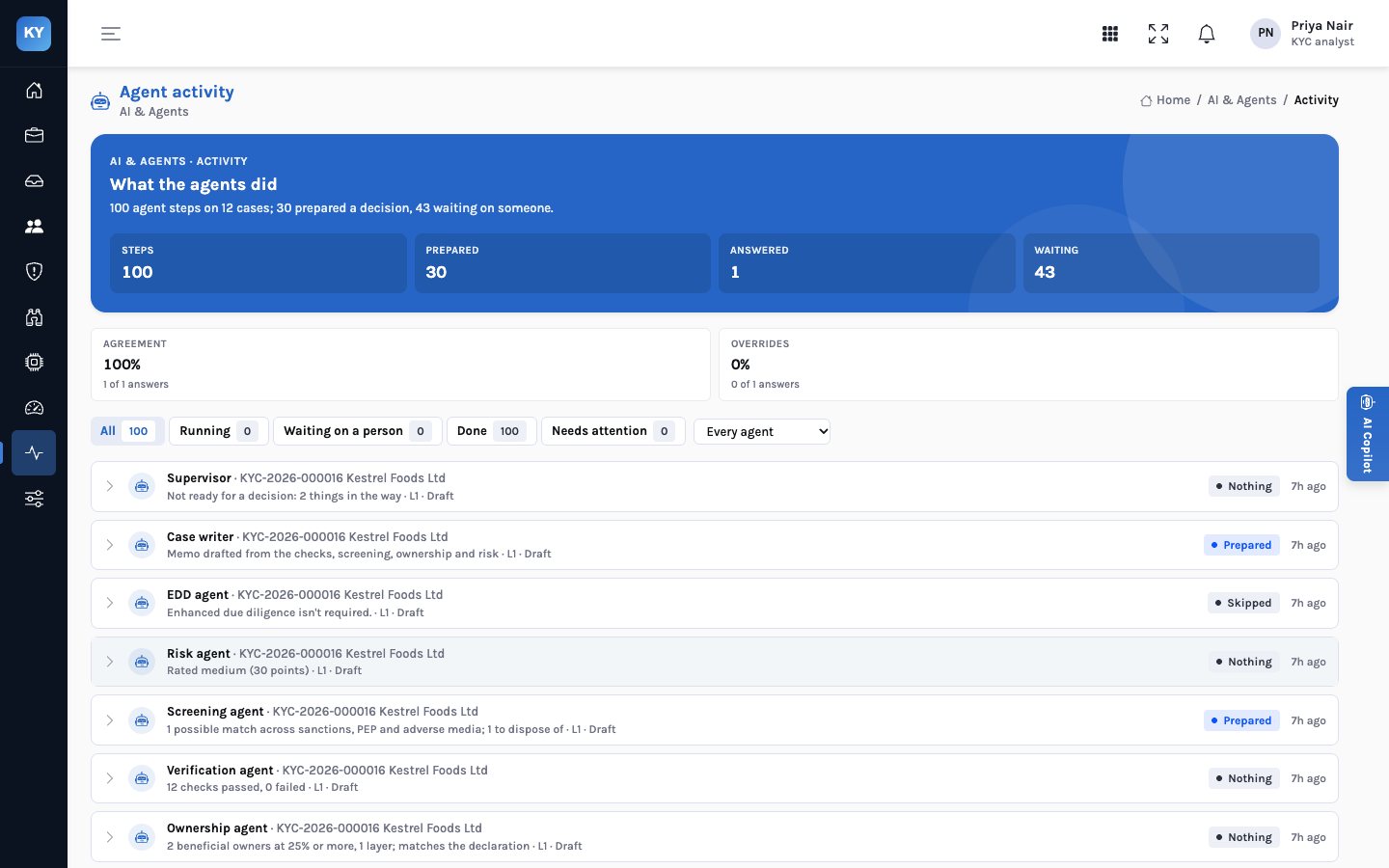
Models time out, return nonsense or become unavailable. A supervisor will ask what the case looks like then. The safest answer is that nothing important depends on the model. In InsightKYC each agent has a rules-only path: with the model switched off, as it is in the demo, the documents are still read by pattern, the checks still run, the screening still scores and the memo is still assembled from the case’s facts. The model improves the wording; it is not a single point of failure.
The model is optional and checked. Anything it adds that is not in the facts is discarded.
What it means for each audience
For the CCO & MLRO
Put every AI component in the model inventory with a one-line answer to “what does it decide?” If the answer is “nothing, a person does”, show where that is enforced.
Keep the validation evidence (planted scenarios, agreement rates, QA results) where an examiner can read it.
For the KYC operations lead
Train analysts that “prepared” means “checked by you”. Make rejecting an agent’s work as normal as accepting it.
When an agent is wrong, the reason recorded with the rejection is how it gets better.
For the board
AI in KYC can make the bank faster and its controls stronger at once, but only if it is designed to be examined.
Ask management one question: can we show, for any case, what the AI did and who decided?
A supervisor will not ask whether you use AI. They will ask what it decides, how you know it works, and who is accountable.
Design so that the honest answers are: nothing on its own, here is the evidence, and a named person.